Wrist Grabs, Bear Hugs, and Chokes: Escaping the Most Common Physical Attacks on Women
This post is part of our Women's Self-Defense training resources.
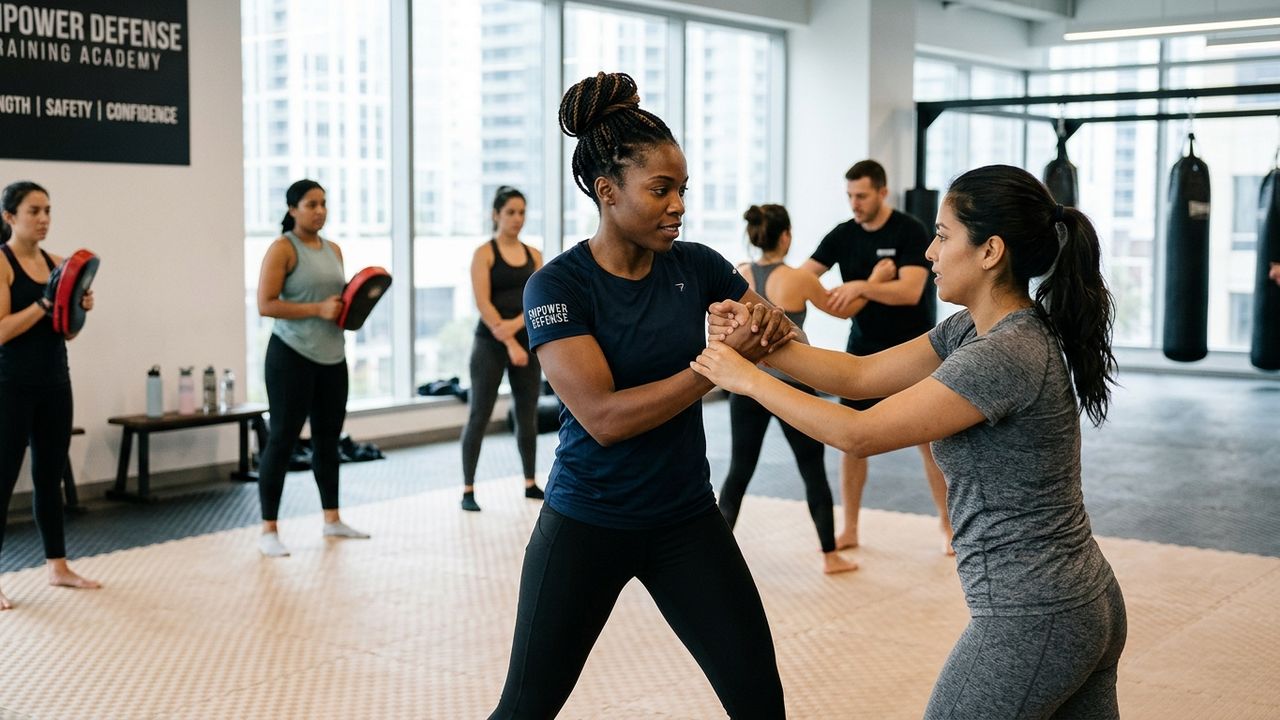
The most common physical attacks on women follow recognizable patterns, and that predictability is actually good news. Wrist grabs, bear hugs, and chokes are all stoppable when you understand the mechanics behind them. You do not need exceptional strength. You need the right technique, practiced enough times that your body remembers it when your mind is flooded with adrenaline.
Why These Three Attacks Appear So Often
Attackers are not strategic martial artists. They are opportunists. Wrist grabs, bear hugs, and chokes are instinctive control methods. They allow an attacker to dominate a person's movement quickly, with minimal skill required on their part. According to the Bureau of Justice Statistics, the majority of violent crimes against women are committed by someone known to the victim, which means these attacks often begin as unwanted physical contact that escalates. Understanding that context shapes how we train.
We teach our students to recognize the moment a situation is shifting from uncomfortable to dangerous. That awareness, combined with a practiced physical response, is the foundation of everything we cover in our Women's Self-Defense program. You can learn more about what that program includes at incendiarytrainingservices.com/women.
Breaking a Wrist Grab: Rotate Toward the Thumb
A wrist grab feels controlling, but it has a built-in weakness. The thumb is the weakest point of any grip. When someone grabs your wrist, the instinctive response is to pull straight back. That rarely works because you are fighting the full strength of their hand. Instead, we teach a rotational pull that drives your wrist directly through the gap between the attacker's thumb and fingers.
The mechanics are simple: step into your attacker's space slightly to reduce tension on the grip, rotate your arm so your elbow drives downward, and pull sharply through the thumb side. We pair this with an immediate follow-up, because breaking a grip without creating distance or delivering a deterrent strike leaves you vulnerable to a second grab. We drill the full sequence, not just the escape.
What Should You Do When Someone Grabs You From Behind?
Bear hugs are disorienting because they remove your visual reference and pin your arms. Your first priority is to drop your center of gravity. Bend your knees, drive your hips back, and widen your stance. This alone makes you significantly harder to lift or carry. A person who cannot be moved is a person who has time to think and act.
From there, your options depend on whether your arms are pinned above or below the elbow. If your arms are free above the elbow, you have access to elbow strikes, head strikes backward, and stomps to the instep. If your arms are fully pinned, the priority shifts to creating space at the hips so you can rotate and generate a strike. We walk through both scenarios in training because attackers are not consistent. You need to be able to adapt in real time.
Choke Defenses: Why Speed and Aggression Matter
A choke, whether from the front or against a wall, is a high-danger scenario. Loss of consciousness can occur in seconds when blood flow to the brain is restricted. This is not a situation where you wait to see what happens next. The response must be immediate and committed.
For a front choke, we teach a technique that combines a simultaneous pluck of the hands, a forward body drive, and a strike. The pluck breaks the grip by attacking the thumbs. The drive closes the distance so the attacker cannot reset. The strike creates enough of a deterrent to allow you to disengage and create space. For a wall choke, the mechanics shift slightly because your movement is restricted, but the core principle remains the same: attack the grip, not the arms holding it.
How Does Stress Change Your Ability to Execute These Techniques?
This is the question that separates useful training from performance. Under real stress, fine motor skills degrade. Techniques that require precise finger placement or complex sequences become unreliable. We build our curriculum around gross motor movements, high repetition, and scenario-based pressure testing. We want your body to know what to do before your brain has finished processing what is happening.
We also spend time on the verbal and pre-contact phase of a confrontation. Most physical attacks are preceded by a period of positioning and escalation. Learning to recognize and interrupt that phase is often more valuable than any single escape technique. Our instructors hold an IKI (Israeli Krav International) Certified Instructor credential, Brazilian Black Belt credential, Monadnock Defensive Tactics (MDTS) Instructor credential, and a Personal Trainer certification. That combination means we approach self-defense as both a tactical and a physical fitness discipline, and we design training that is realistic for the people in the room.
Building a Training Habit That Actually Sticks
One session is a starting point, not a finish line. We encourage every participant to treat their first training as an introduction to a practice, not a checklist item. That said, even a single focused session builds meaningful awareness. You will leave knowing how your body responds under simulated pressure, where your instincts are already working for you, and where they need refinement.
We work with individuals, small groups, corporate teams, faith communities, and civic organizations. If you have a group of women who want to train together, that is one of the most effective formats we offer. Shared training builds accountability, and practicing with people you trust accelerates learning. We bring the training to you, so there is no commute, no unfamiliar gym, and no barrier to getting started.
We serve Greater New Orleans and southeastern Louisiana, and because we are fully mobile, we come directly to your location. Whether you are organizing a session for your workplace, your neighborhood, or your family, we are ready to build something that fits your group. Reach out today at https://incendiarytrainingservices.com/contact and let us know what you are looking for. We will put together a training plan that meets your group where you are.


