Women's Parking Lot Safety Tips: How to Reduce Risk Before You Reach Your Car
This post is part of our Women's Self-Defense training resources.
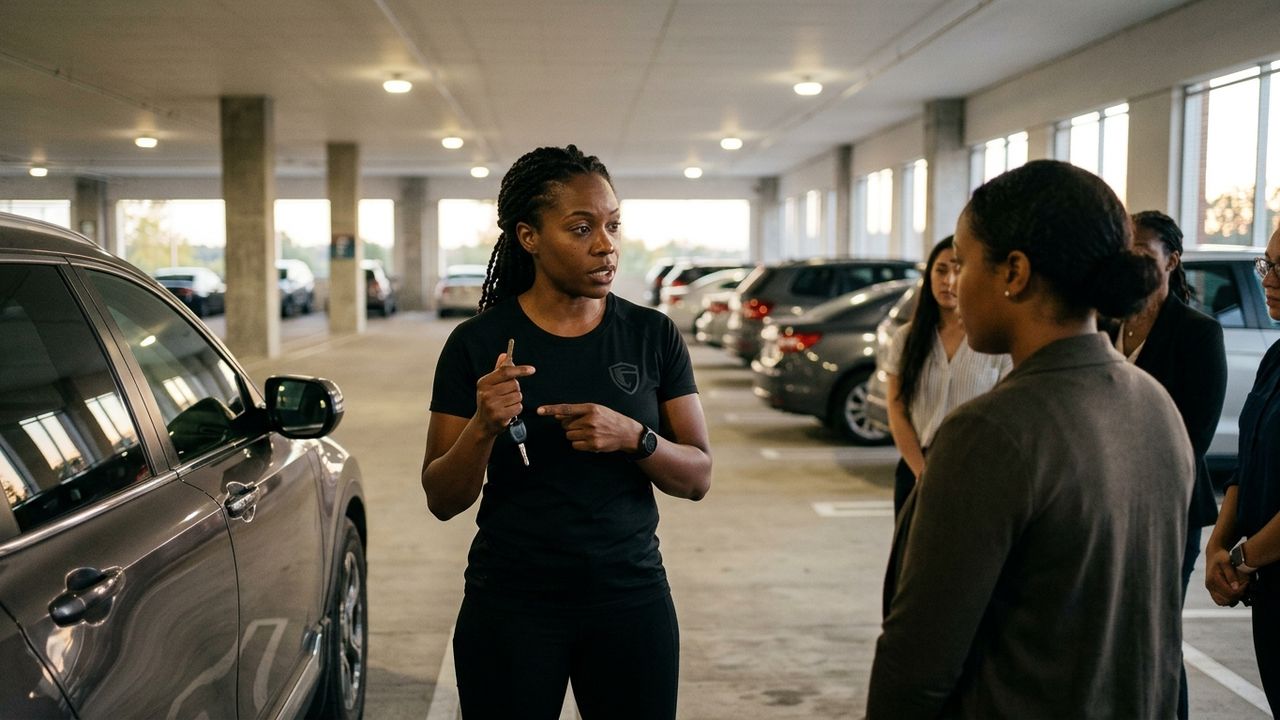
The most effective parking lot safety strategy starts before you ever open a car door. Reducing risk is about building consistent habits around awareness, positioning, and preparation. You do not need to live in fear, but you do need a plan, and the good news is that these skills are completely learnable.
Why Parking Lots Demand a Different Level of Attention
Parking lots and garages create a unique set of vulnerabilities. They combine low natural surveillance, poor lighting in many areas, physical isolation between vehicles, and a population of people who are distracted by bags, phones, and keys. According to the Bureau of Justice Statistics, parking lots and garages are among the most frequently cited locations for personal crimes, including robbery and assault. That data point is not meant to alarm you. It is meant to explain why we treat parking lot awareness as a foundational skill in our women's self-defense programming.
Most incidents in these environments are not random. They follow patterns, and patterns can be disrupted. When you understand what makes someone a harder target, you can make small adjustments that shift the dynamic significantly.
What Does Situational Awareness Actually Look Like in a Parking Lot?
We hear the phrase "stay aware" constantly, but it rarely comes with practical instruction. Here is what we teach our students to actually do. As you approach a parking area, take a deliberate scan of the space before you commit to walking into it. Look for people loitering near vehicles, anyone who appears to be watching foot traffic, and areas where sightlines are blocked by large vehicles or pillars.
Put your phone away before you enter the lot. We know that feels counterintuitive because your instinct may be to look busy or to call someone for comfort. Calling a friend while walking is not a safety strategy. It divides your attention at exactly the moment you need it most. Keep your head up, make brief eye contact with people around you, and walk with a pace and posture that communicates confidence and presence. Body language is not a guarantee of anything, but it does influence how you are perceived.
Practical Habits to Build Before You Even Leave the Building
Safety in a parking lot begins with decisions you make before you step outside. Here are the habits we reinforce in every women's self-defense session we teach.
Have your keys ready before you exit the building. Fumbling for keys at your car door is one of the most common vulnerability windows. Know which key you need and hold it in your hand before you walk out.
Park strategically. When you have a choice, park near building entrances, in well-lit areas, and away from large vans or trucks that block sightlines. If you are returning to your car after dark and the lot looks different than when you arrived, trust that instinct and ask for an escort.
Check the back seat before you get in. This takes two seconds and is a habit worth building permanently. Once you are inside, lock your doors immediately. Do not sit in a parked car with unlocked doors while you check your phone.
Trust discomfort. If something feels off, it is okay to turn around, re-enter the building, and wait. You do not owe anyone an explanation for prioritizing your own safety.
What Should You Do If Someone Approaches You Aggressively?
This is where training makes a measurable difference. Awareness and positioning reduce risk, but they do not eliminate every scenario. When someone closes distance on you in a way that feels threatening, your ability to respond effectively depends on whether you have practiced a response or are encountering it for the first time under stress.
We teach our students to use a clear verbal boundary first. A loud, direct "Stop. Back up." serves two purposes: it signals to the other person that you are not an easy target, and it draws attention from bystanders. From there, the response depends on the situation. Our curriculum covers distance management, breaking grabs, and creating space to escape, all grounded in real-world scenarios rather than sport-based techniques. You can learn more about what we cover on our Women's Self-Defense page.
The Role of Physical Training in Parking Lot Safety
Awareness and habits take you far. Physical skills take you further. We integrate self defense tactics drawn from multiple disciplines specifically because these systems were built for real-world application, not competition. The goal is not to turn every student into a fighter. The goal is to give you enough physical skill to create distance, break contact, and get away.
Our instructors hold an IKI (Israeli Krav International) Certified Instructor credential, Brazilian Black Belt credential, Monadnock Defensive Tactics (MDTS) Instructor credential, and a Personal Trainer certification.
That combination means we can address the physical fitness component of self-defense alongside the tactical skills. Being able to move quickly, maintain balance under pressure, and sustain effort for even a short burst matters in a real confrontation. We build those capacities together.
Building a Culture of Safety at Work and in Your Community
Parking lot safety is not only an individual responsibility. Employers, property managers, and community organizations all have a role to play. If you are a team leader or HR professional reading this, consider what your organization is doing to support the women on your staff who walk to their cars after late shifts, evening events, or long workdays.
We regularly work with corporate teams to deliver group women's self-defense training as part of broader workplace safety initiatives. These sessions build shared language, shared skills, and a stronger culture of looking out for one another. When a group of coworkers all understand the same awareness principles, they reinforce each other's habits every day.
We are a mobile training service, which means we bring the instruction to your location. No commute, no renting a facility, no scheduling headaches. We come to you, set up, and deliver a session that fits your team and your space.
If you are ready to move from awareness to action, we are here to help. We serve individuals, groups, and organizations throughout Greater New Orleans and southeastern Louisiana, and we come to you. [Reach out today](https://incendiarytrainingservices.com/contact) to tell us about your situation and we will put together a training plan that meets you where you are.


