How to Choose a Self-Defense Instructor: 5 Questions to Ask Before You Commit
This post is part of our Self-Defense Training training resources.
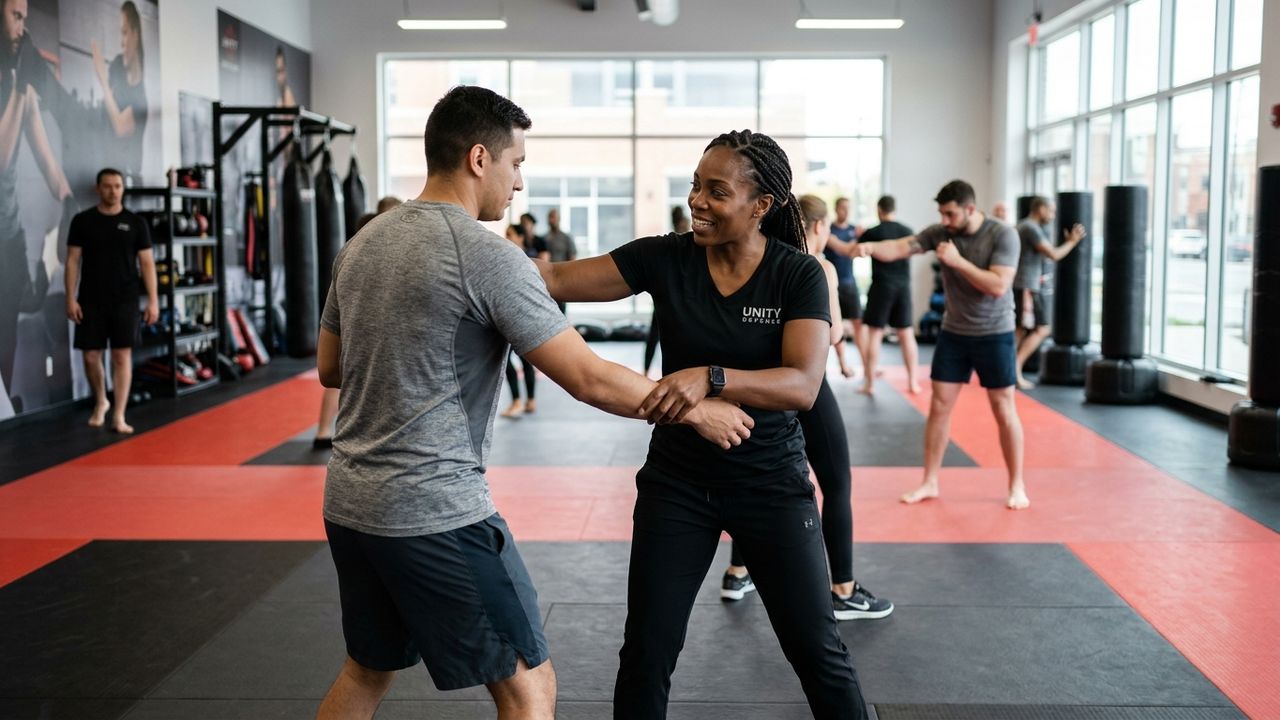
Knowing how to choose a self-defense instructor comes down to five core questions: What are their verified credentials? Do they teach practical, pressure-tested skills? Can they adapt to your environment and team? How do they handle liability and safety? And do they treat you like a capable adult? Ask those five questions, and the right instructor will stand out quickly.
Why Choosing the Right Instructor Is a Safety Decision, Not Just a Budget Decision
We hear it often: someone took a one-hour seminar years ago and walked away feeling confident, only to freeze when a real situation unfolded. That gap between classroom confidence and real-world capability is almost always a training quality problem, not a student problem. The instructor you choose shapes not just what you learn, but how deeply you internalize it and whether it holds up under stress.
According to the FBI, workplace violence accounts for roughly 20 percent of all violent crimes in the United States. That context matters when you are evaluating who should be standing in front of your team. The stakes are real, and the instructor you bring in should treat them that way.
Question 1: What Credentials Do You Actually Hold?
This is the first question, and it should be non-negotiable. Anyone can film a few YouTube videos and call themselves a self-defense expert. Legitimate instructors hold verifiable, current credentials from recognized organizations and can name them specifically when asked.
We are transparent about ours because we believe you deserve that clarity. Our instructors hold an IKI (Israeli Krav International) Certified Instructor credential, Brazilian Black Belt credential, Monadnock Defensive Tactics (MDTS) Instructor credential, and a Personal Trainer certification.
Notice what that combination represents: a striking and combatives system, a grappling foundation, a professional defensive tactics framework, and the physical training knowledge to work safely with people of varying fitness levels. When you evaluate any instructor, look for that kind of layered, verifiable background rather than a single style or a vague claim of "years of experience."
Question 2: Does the Curriculum Reflect Real-World Scenarios?
Sport-based martial arts are valuable disciplines, but they are built around rules, referees, and weight classes. Real threats do not follow those rules. A quality self-defense program should address the situations your participants are actually likely to face: a grab in a parking garage, a confrontation in a hallway, a physical escalation in a workplace setting.
Ask the instructor to walk you through a sample scenario. If the answer sounds like a tournament drill, keep looking. Our [defensive tactics training](https://incendiarytrainingservices.com/services/defensive-tactics) is built around exactly this principle: skills that are simple enough to access under adrenaline, tested against realistic pressure, and relevant to the environments our clients actually work and live in.
Question 3: Can You Train in Our Space, With Our People?
A rigid instructor who only trains in a dedicated gym is limiting your team before the session even starts. The best self-defense training happens in context. When your staff practices de-escalation and physical response techniques in the actual hallways, break rooms, or parking areas they use every day, the skills become anchored to that environment. That is a real advantage.
We are a fully mobile operation. We come to your location, whether that is a corporate office, a community center, a healthcare facility, or an outdoor venue. We adapt the curriculum to your space, your team size, and your specific concerns. That flexibility is not a convenience feature; it is a core part of how we deliver effective training.
Question 4: How Do You Handle Participant Safety and Physical Limitations?
Any instructor worth hiring has a clear answer to this question before you ask it. Training groups are rarely uniform. You may have participants with prior injuries, varying fitness levels, or physical limitations that require modification. A qualified instructor builds those accommodations into the session design, not as an afterthought, but as a standard part of professional delivery.
Ask specifically: How do you modify techniques for participants with limited mobility? What is your protocol if someone is injured during a session? What does your liability coverage look like? A professional will answer those questions directly and without hesitation. Vague or defensive responses are a warning sign.
Question 5: What Does the Training Actually Ask of Participants?
Good self-defense training is not passive. It requires participants to engage, make decisions under simulated stress, and practice physical responses. If an instructor describes a program that is mostly lecture and demonstration with minimal hands-on work, the retention rate for those skills will be low. The research on motor learning is clear: you have to do the thing, not just watch it.
At the same time, a responsible instructor does not push participants past safe limits or create an environment where people feel humiliated or coerced. We build sessions that are challenging and honest without being reckless. Participants should leave feeling more capable and more aware, not bruised and overwhelmed.
Putting It All Together Before You Sign Anything
Once you have asked these five questions, compare the answers against what you actually need. A corporate team preparing for workplace safety scenarios has different priorities than a group of healthcare workers managing patient confrontations, which is different again from a civilian group focused on personal safety. The right instructor listens to those distinctions and builds accordingly.
We also want to be straightforward about what good training does not promise. No program can guarantee your safety in every situation. What quality instruction does is raise your awareness, sharpen your decision-making, and give you a set of physical tools you can access under stress. That is a meaningful and realistic outcome, and it is what we work toward in every session.
If you are ready to bring qualified, credentialed, scenario-based self-defense training to your team, we are ready to come to you. We serve Greater New Orleans and southeastern Louisiana, and as a fully mobile operation, we travel to your location so your team trains where they work and live. [Reach out today](https://incendiarytrainingservices.com/contact) to tell us about your group and let us build a session that fits.
