Control Holds and Restraint Techniques for Non-Law-Enforcement Security Personnel
This post is part of our Law Enforcement & Security training resources.
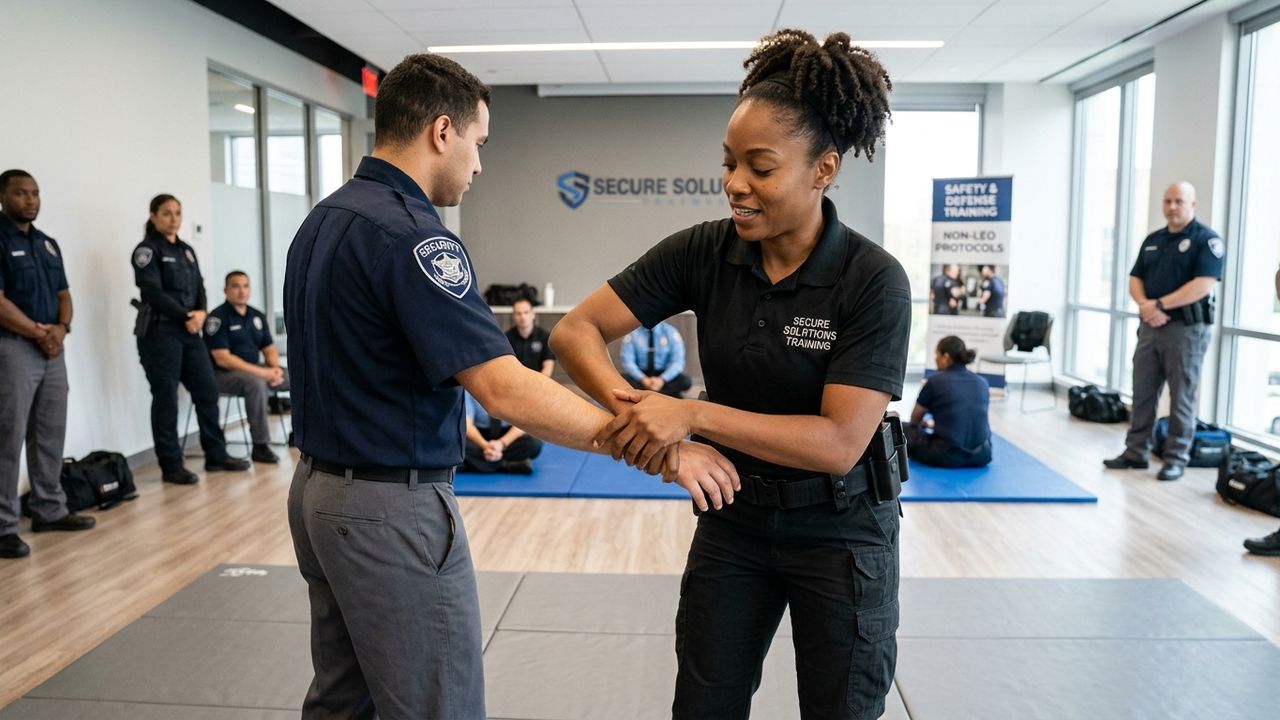
Restraint techniques for security guards and workplace safety personnel are not about aggression. They are about control, de-escalation, and protecting everyone in the room, including the person causing the disruption. When applied correctly and within a clear use-of-force framework, control holds give non-law-enforcement professionals a measured, proportional tool for managing physical confrontations without making a dangerous situation worse.
Why Workplace Violence Training Matters More Than Ever
OSHA recognizes workplace violence as a serious occupational hazard, noting that it affects nearly two million American workers every year across industries ranging from healthcare to retail to corporate offices. That number does not shrink on its own. It shrinks when organizations invest in preparation. For teams that include in-house safety personnel, front-desk staff, or anyone tasked with managing access and order, having a practical skill set for physical intervention is not optional anymore. It is a core component of a responsible safety plan.
We work with corporate teams, facility managers, and workplace safety coordinators through our Law Enforcement and Security training program to build exactly this kind of readiness. Our curriculum is designed for real environments, not theoretical ones.
What Is a Control Hold and How Is It Different from a Restraint?
These two terms are often used interchangeably, but they describe different points on the same spectrum. A control hold is a technique used to guide, redirect, or limit the movement of an individual without taking them fully off their feet or rendering them immobile. Think of an escort hold, a wrist lock used to steer someone away from a situation, or a standing arm bar that discourages further aggression. A restraint goes further, typically involving ground control or the use of a mechanical restraint device, and it carries significantly more legal and liability weight for non-law-enforcement personnel. We teach both, but we spend a great deal of time helping teams understand where each technique belongs in a use-of-force continuum.
The Techniques We Cover in Training
Our curriculum draws from multiple proven systems and is calibrated for the non-law-enforcement professional. We focus on techniques that are effective under stress, easy to retain with periodic practice, and defensible from a liability standpoint. Core areas include:
Escort and compliance holds: Low-force techniques for guiding a non-compliant individual out of a space without injury to either party. These are the most frequently used and the most important to master first.
Wrist and arm control: Leveraged positions that create pain compliance and redirect movement without requiring significant strength. These are drawn from our Brazilian Jiu-Jitsu and Krav-based curriculum and are highly practical in close-quarters environments.
Standing clinch and body control: Techniques for managing an individual who has become physically combative, keeping the situation upright and reducing the risk of a ground struggle in a public or workplace setting.
Ground control fundamentals: For situations that have already gone to the ground, we teach positional control and safe disengagement, not prolonged ground fighting. The goal is always to create distance and wait for additional support.
Our instructors hold an IKI (Israeli Krav International) Certified Instructor credential, Brazilian Black Belt credential, Monadnock Defensive Tactics (MDTS) Instructor credential, and a Personal Trainer certification. That combination means we are drawing from systems that were specifically designed for real-world application under pressure, not sport competition.
What Should Your Team Know Before Physical Intervention Is Ever Necessary?
Physical technique is the last line of a well-designed safety response, not the first. Before any hands-on skill comes into play, your team needs a solid foundation in three areas. First, situational awareness: recognizing behavioral indicators before a situation becomes physical. Second, verbal de-escalation: the ability to slow a situation down using tone, positioning, and word choice. Third, clear internal policy: your team needs to know exactly what they are authorized to do, when they are authorized to do it, and what the escalation chain looks like. We cover all three in our training sessions because physical skills without context and policy are a liability, not an asset.
How We Tailor Training for Non-Law-Enforcement Teams
We want to be direct about something important. This training is not a guard-card or licensure program. We are not certifying anyone for a security license, and we are not delivering POST-accredited law enforcement hours. What we are doing is giving your team practical, scenario-based skills that make them more capable and more confident when a situation goes sideways. That applies to corporate safety teams, hospital staff, property management personnel, event coordinators, and any other professional group that may face a physical confrontation in the course of their work.
We build every session around the specific environment and risk profile of your team. A retail management group has different needs than a hospital triage staff or a corporate HR team conducting a termination. We ask the right questions before we ever show up so that the training we deliver is relevant from the first drill to the last.
Building a Culture of Preparedness, Not Fear
One of the things we hear most often after a training session is that participants feel calmer, not more anxious. That is intentional. When people have a clear, practiced response to a threatening situation, the fear of the unknown shrinks. They are not imagining worst-case scenarios with no plan. They have a framework, a set of practiced skills, and a team that has trained together. That shared experience changes how a group functions under pressure in ways that no policy document alone can replicate.
We also make a point of keeping the tone of our sessions grounded and realistic. We do not sensationalize threats or manufacture urgency. We present the skills, we explain the context, and we let your team build confidence through repetition and honest feedback. That is how real preparedness is built.
Ready to Train Your Team? We Come to You.
If your organization is ready to invest in practical, instructor-led control and restraint training, we are ready to bring it directly to your facility. We serve Greater New Orleans and southeastern Louisiana, and because we are fully mobile, we come to you, whether that is your office, your warehouse floor, your training room, or your parking lot. [Reach out today](https://incendiarytrainingservices.com/contact) to tell us about your team, your environment, and your goals. We will put together a session that fits your people and your workplace.

