Use-of-Force Continuums Explained: A Practical Guide for Security Professionals
This post is part of our Law Enforcement & Security training resources.
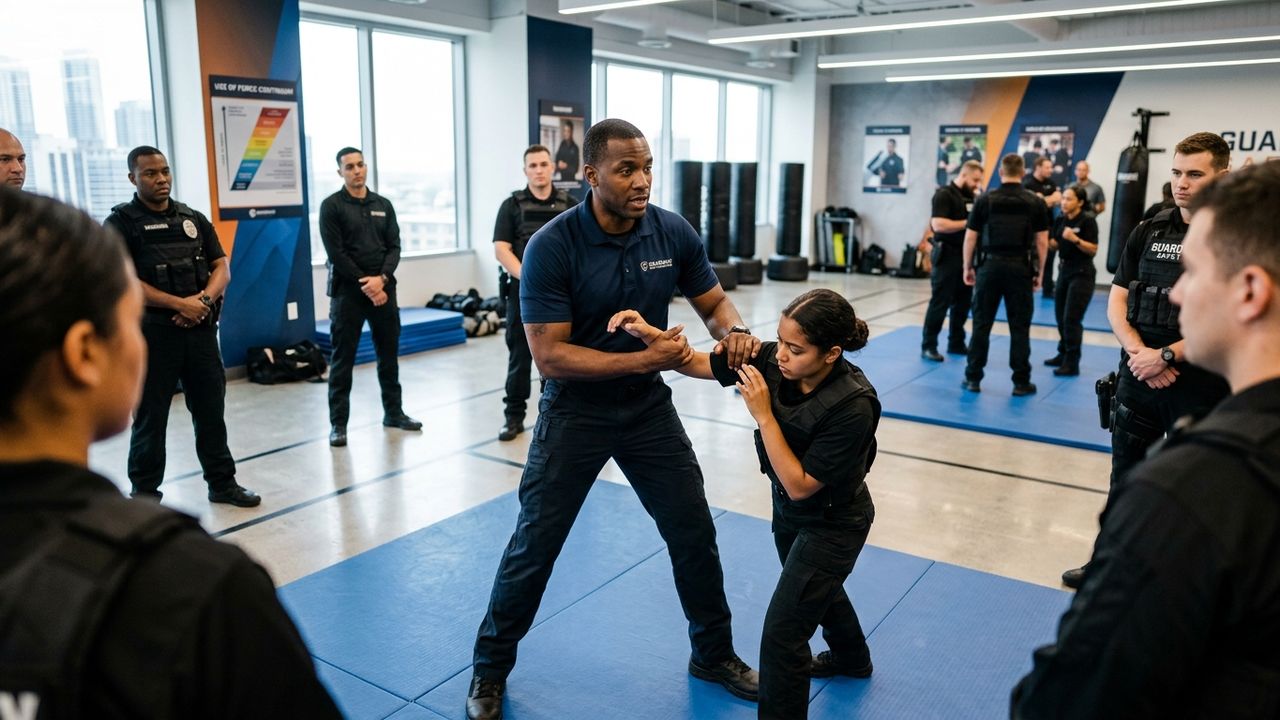
A use-of-force continuum is a structured framework that guides professionals through escalating levels of response, from verbal commands to physical intervention, based on the threat level they face. For security professionals and workplace safety teams, understanding this framework is not optional. It is the foundation of every sound, defensible decision made in a high-pressure moment.
What Is a Use-of-Force Continuum and Why Does It Matter?
At its core, a use-of-force continuum maps out a proportional response to a given threat. The idea is straightforward: the level of force applied should match the level of threat presented. When that principle is followed consistently, professionals protect themselves legally, protect the people around them physically, and create a clear record of decision-making that holds up under scrutiny.
The continuum typically moves through several stages: officer presence, verbal commands, soft empty-hand control, hard empty-hand control, intermediate weapons, and lethal force. Not every situation will move through every stage, and a trained professional should be able to enter and exit the continuum at any point based on how the threat evolves. That flexibility is exactly why scenario-based training matters so much.
The Real-World Stakes: Workplace Violence Is Not a Rare Event
OSHA recognizes workplace violence as a serious occupational hazard, noting that it affects nearly two million American workers every year across industries. That number includes threats, physical assaults, and confrontations that never make the evening news but still leave teams shaken and organizations exposed. Security professionals and workplace safety teams sit at the front line of managing those moments, and their ability to respond proportionally and confidently is what separates a contained incident from a catastrophic one.
We work with corporate teams, workplace safety personnel, and law enforcement professionals across Greater New Orleans and southeastern Louisiana. In every session, we see the same gap: people understand the concept of proportional response in theory but freeze when they have to apply it in real time. That gap is exactly what structured continuum training closes.
Breaking Down Each Stage of the Continuum
Let us walk through the stages in practical terms, because textbook definitions only go so far.
Officer or professional presence is the first and least intrusive level. Simply being visible, calm, and authoritative can de-escalate a situation before a single word is spoken. Posture, positioning, and awareness all communicate readiness without aggression.
Verbal commands come next. Clear, direct, calm communication is a skill, not a default. We train teams to use language that gives subjects a clear path to compliance, which reduces the likelihood of escalation. De-escalation is not weakness. It is the most efficient tool available when it works.
Soft empty-hand control involves guiding, redirecting, or restraining without strikes. This is where foundational grappling and control skills become critical. Hard empty-hand control escalates to strikes or takedowns when softer control is not sufficient. Both require trained muscle memory, because fine motor skills degrade sharply under adrenaline.
Intermediate weapons such as batons, OC spray, and similar tools occupy the next tier. Our Monadnock Defensive Tactics (MDTS) training specifically addresses baton and control tool deployment within a continuum framework. Finally, lethal force represents the final stage, reserved for situations involving an imminent threat of death or serious bodily harm. Understanding where that threshold sits, and being able to articulate why it was crossed, is non-negotiable.
What Does Good Continuum Training Actually Look Like?
Good training does not just explain the levels. It puts people inside them. We use scenario-based drills that force participants to read a situation, choose a response level, execute it, and then reassess as conditions change. That loop, read, decide, act, reassess, is what builds the kind of judgment that holds up when the stakes are real.
We integrate Krav Maga principles, Brazilian Jiu-Jitsu ground control, and MDTS baton and control tool techniques into a single cohesive curriculum. Our instructors hold an IKI (Israeli Krav International) Certified Instructor credential, Brazilian Black Belt credential, Monadnock Defensive Tactics (MDTS) Instructor credential, and a Personal Trainer certification. That combination means we can address the full range of the continuum, from the physical conditioning needed to sustain a struggle to the technical skills needed to end one safely.
We also emphasize documentation and articulation. Knowing how to act is only half the job. Being able to clearly explain why you acted, in a report, in a debrief, or in a legal proceeding, is equally important. We build that habit into training from day one.
How This Applies to Workplace Safety Teams (Not Just Law Enforcement)
A common misconception is that use-of-force frameworks are exclusively for sworn officers. They are not. Any professional who may face a threatening situation, whether in a hospital, a corporate lobby, a warehouse, or a retail environment, benefits from understanding how to escalate and de-escalate proportionally. The principles apply universally, even when the tools and legal authority differ.
Our [Law Enforcement and Security training programs](https://incendiarytrainingservices.com/services/law-enforcement-security) are designed to serve both sworn professionals looking for supplemental skill-building and workplace teams that need practical, legally grounded safety skills. We tailor every session to the specific environment and threat profile of the group we are working with.
Building a Culture of Preparedness on Your Team
One training session is a starting point, not a finish line. We encourage organizations to think about use-of-force continuum training as an ongoing practice rather than a one-time compliance checkbox. Threat environments change. Team composition changes. Legal standards evolve. Regular training keeps your people sharp, your policies current, and your organization protected.
We also believe that confident, well-trained teams are calmer teams. When people know they have the skills to handle a situation, they are less likely to over-react and less likely to freeze. That composure is contagious, and it shapes the entire culture of how an organization responds to risk.
If your team is ready to build that foundation, we are ready to bring the training to you. We serve Greater New Orleans and southeastern Louisiana, and because we are fully mobile, we come directly to your facility so your team trains in the environment they actually work in. [Reach out today](https://incendiarytrainingservices.com/contact) to talk through your team's needs and schedule a session.
