Crowd Control Communication: How Security Teams Can Manage Large Groups Without Force
This post is part of our De-Escalation training resources.
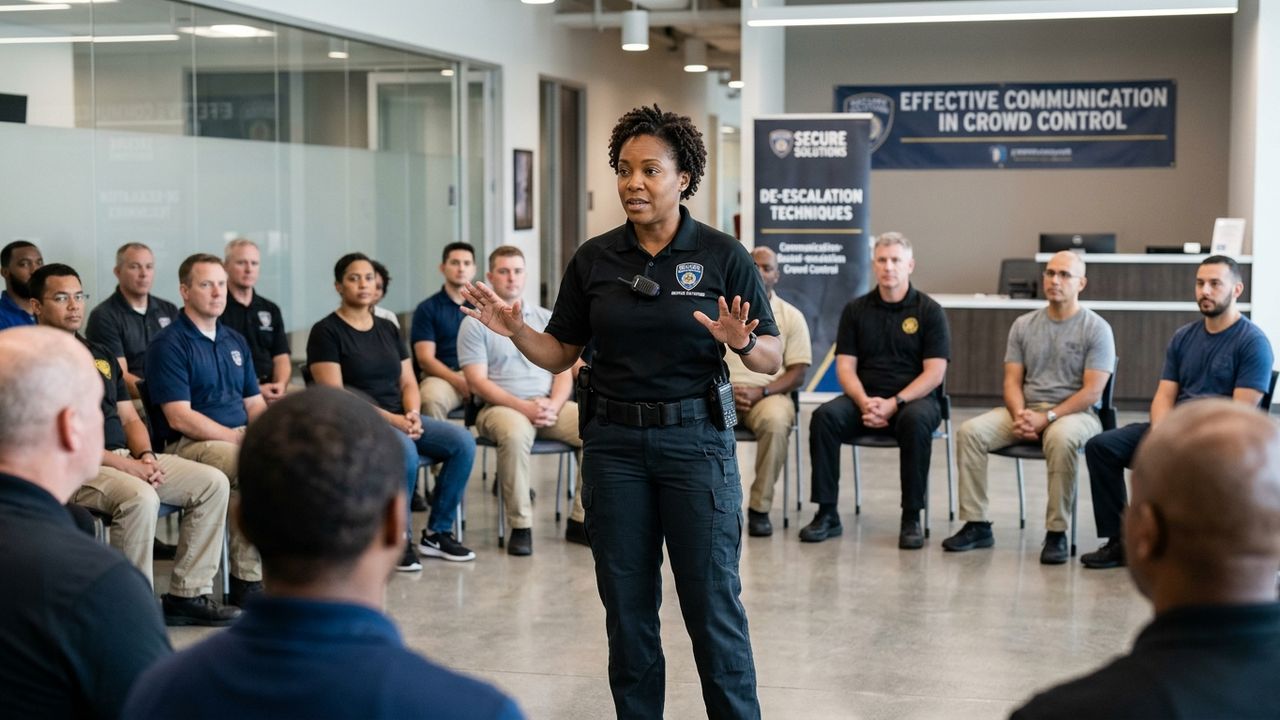
Security teams can manage large groups without force by mastering three fundamentals: early intervention, clear verbal communication, and deliberate positioning. When those skills are trained and practiced before an event, the need for physical control drops dramatically. Force is a last resort, and communication is the first line of defense.
Why Communication Is the Core of Crowd Control De-Escalation Security Training
Most crowd incidents do not start with violence. They start with frustration, confusion, or a perceived lack of fairness. A long line that is not moving, unclear instructions, or a single confrontational interaction can ignite tension across an entire group. That is why we teach teams to treat communication as a tactical skill, not just a soft skill.
According to OSHA, workplace violence affects nearly two million workers in the United States each year, and high-density public-facing environments carry elevated risk. Events, venues, transit hubs, and large corporate gatherings all create conditions where emotions can escalate quickly. The teams that handle those environments best are the ones who have trained for them specifically.
Our de-escalation training programs are built around exactly this reality. We give teams practical, scenario-based tools they can apply in the moment, under pressure, with real people in real environments. You can learn more about what that looks like on our De-Escalation Training service page.
What Does Effective Crowd Communication Actually Look Like?
Effective crowd communication is calm, confident, and specific. Vague instructions create anxiety. Anxious crowds become unpredictable crowds. We train teams to use what we call directive language, short, clear, actionable statements that tell people exactly what to do rather than what not to do. "Please move to the right side of the corridor" lands better than "Do not block the entrance." The first gives people a path forward. The second just creates friction.
Tone matters just as much as words. A team member who sounds nervous or aggressive will transmit that energy to the crowd. We work with teams on vocal control, body language, and physical positioning so that their presence itself communicates authority and calm. This is not about being robotic. It is about being grounded.
We also train teams to identify and engage what we call crowd anchors, the individuals whose behavior influences those around them. In any group, a small number of people set the emotional tone for the rest. Reaching those individuals early, before tension spreads, is one of the highest-leverage moves a trained communicator can make.
Positioning, Proximity, and the Geometry of Crowd Management
Where your team stands matters. Positioning is a communication tool in its own right. A team member who is visible, accessible, and stationed at natural chokepoints or transition zones can interrupt problems before they compound. We teach teams to think about sightlines, flow patterns, and the natural geometry of the spaces they work in.
Proximity is equally important. Moving too close to an agitated individual can feel threatening and escalate the situation. Staying too far away signals disengagement and can embolden disruptive behavior. We train teams to find the right distance for each situation, close enough to communicate clearly, far enough to give the other person space to make a better choice.
How Do You Train a Team to Stay Calm When a Crowd Is Not?
This is the question we hear most often, and it is the right one to ask. Staying regulated under stress is a trainable skill. We use scenario-based drills that put teams under realistic pressure so that the physiological stress response, the elevated heart rate, the tunnel vision, the impulse to react, becomes familiar and manageable rather than overwhelming.
We also build team communication protocols into every program. When individuals know their role, their position, and who they are communicating with, they make better decisions under pressure. Confusion is the enemy of calm. Clarity is the foundation of it.
Our instructors hold an IKI (Israeli Krav International) Certified Instructor credential, Brazilian Black Belt credential, Monadnock Defensive Tactics (MDTS) Instructor credential, and a Personal Trainer certification. That combination means we bring both the physical tactics background and the practical training methodology to build skills that hold up when the pressure is real.
Building a Culture of Prevention on Your Team
The best crowd management happens before anyone raises their voice. Teams that train together develop a shared language, shared situational awareness, and a shared commitment to resolution over reaction. That culture does not happen by accident. It is built through deliberate, repeated practice.
We design our programs for corporate safety teams, event staff, venue management, law enforcement looking to supplement their skills, and any organization that regularly puts people in high-density, high-stakes environments. These are not guard-card or licensure programs. They are practical, team-based skill-building workshops that make your people more effective in the moments that matter.
Every program we deliver is tailored to your environment, your team size, and your specific risk profile. We do not teach generic concepts in a vacuum. We train for the situations your team will actually face.
Ready to Build Stronger Communication Skills Across Your Team?
We serve teams throughout Greater New Orleans and southeastern Louisiana, and because we are fully mobile, we come to you. No need to coordinate travel or find a facility. We bring the training to your location, your schedule, and your team. If you are ready to give your people the communication and de-escalation skills they need to manage crowds with confidence, Reach out today and let us build a program that fits your team.


