De-Escalation Training for Managers: How to Defuse Angry Employees Before Situations Turn Physical
This post is part of our De-Escalation training resources.
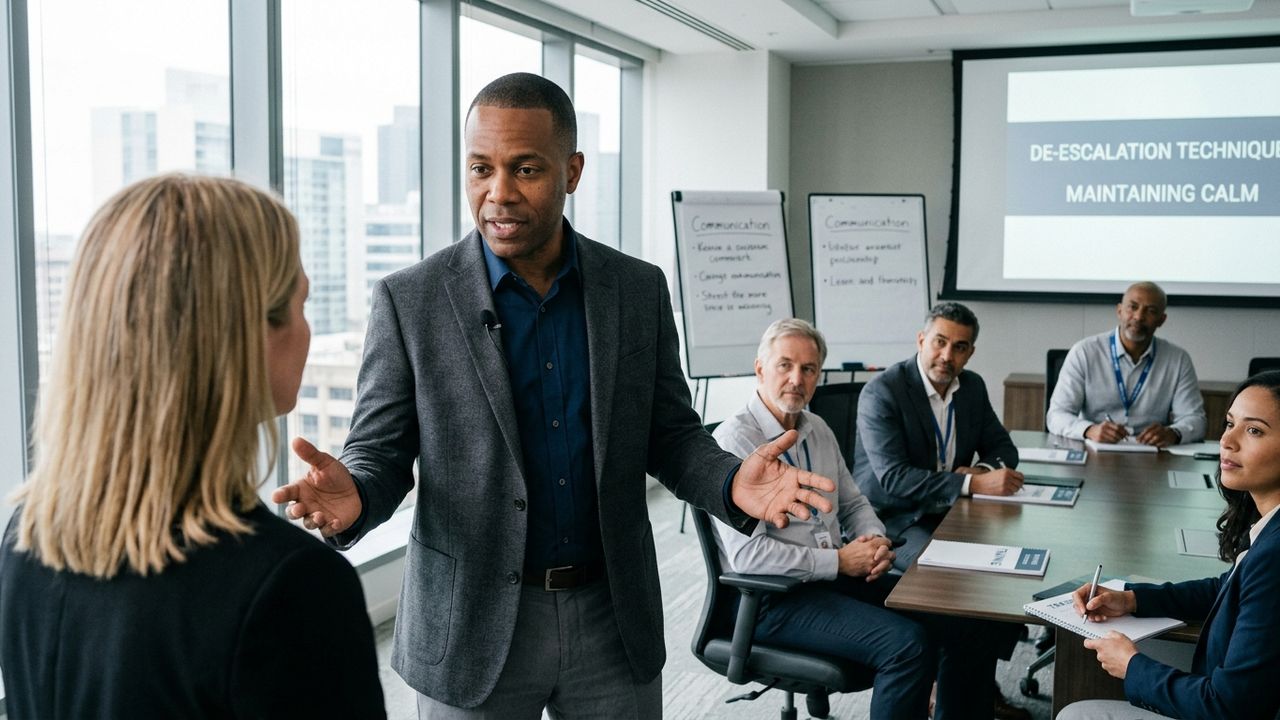
De-escalation training for managers works by giving leaders a structured, practiced set of verbal and physical skills to interrupt the emotional escalation cycle before it reaches a breaking point. When managers know how to read warning signs, regulate their own stress response, and communicate with a dysregulated employee, they dramatically reduce the chance that a tense moment becomes a dangerous one.
Why Workplace Violence Is a Management Problem, Not Just a Security Problem
OSHA identifies workplace violence as one of the leading causes of job-related injury and death in the United States, and the agency is clear that employers have a general duty to provide a workplace free from recognized hazards. That duty does not fall only on a security team or an HR department. It falls on every person in a supervisory role.
Managers are often the first people in the room when an employee starts to unravel. They are the ones delivering difficult news, enforcing unpopular policies, and navigating interpersonal conflict between team members. Without proper training, even a well-meaning manager can accidentally escalate a situation by using the wrong tone, the wrong body language, or the wrong words at the wrong moment.
We built our de-escalation training programs specifically to close that gap. You can learn more about what we cover on our [de-escalation service page](https://incendiarytrainingservices.com/services/de-escalation-training).
What Does Escalation Actually Look Like in the Workplace?
Escalation rarely starts with a thrown object or a raised fist. It usually starts with something much quieter: a clenched jaw during a performance review, a voice that keeps climbing in volume, a person who stops making eye contact and starts scanning the room. These are behavioral cues that signal a nervous system moving toward a threat response.
We teach managers to recognize these early indicators because the window for effective verbal intervention is widest at the beginning of the cycle. Once a person crosses into a full fight-or-flight state, the part of the brain responsible for rational conversation is largely offline. Trying to reason with someone at that point is not just ineffective, it can make things worse.
Our training covers the full behavioral spectrum, from low-level agitation all the way to pre-attack indicators, so managers understand exactly where they are in a situation and what their options are at each stage.
The Core Skills We Build in De-Escalation Training for Managers
Effective de-escalation is not about being passive or giving in. It is about being strategic. We focus on four core skill areas that every manager can develop with practice.
Emotional self-regulation: A manager who is visibly anxious or reactive will amplify the emotional state of an agitated employee. We work on breathing techniques and grounding strategies that help managers stay calm and project calm.
Verbal tone and pacing: How something is said matters as much as what is said. We train managers to slow their speech, lower their volume, and use open-ended language that invites the other person to feel heard rather than cornered.
Spatial awareness and positioning: Where you stand, how close you are, and whether you are blocking an exit all send signals to an agitated person. We teach managers to position themselves in ways that reduce perceived threat without creating vulnerability.
Knowing when to disengage: Sometimes the most effective de-escalation move is to end the interaction, create physical distance, and involve additional resources. We help managers recognize that moment and act on it without hesitation or guilt.
What Happens When De-Escalation Is Not Enough?
We want to be honest about this: de-escalation skills are powerful, but they are not a guarantee. Some situations move faster than training can fully prepare for, and some individuals are in a state where verbal intervention will not work. That is why we believe de-escalation training should sit inside a broader personal safety framework.
Our instructors hold an IKI (Israeli Krav International) Certified Instructor credential, Brazilian Black Belt credential, Monadnock Defensive Tactics (MDTS) Instructor credential, and a Personal Trainer certification.
That depth of credential means we can connect the dots between verbal de-escalation and physical safety in a way that most corporate trainers cannot. When we teach a manager to create distance and disengage, we are also teaching them what to do if that distance is closed against their will. The two skill sets belong together.
How We Structure Training for Corporate Teams
We design every session around the specific environment and risk profile of the team we are working with. A manager at a distribution center faces different dynamics than a manager at a financial services firm. We ask the right questions before we ever show up, so the training feels relevant from the first minute.
Our sessions are scenario-driven. We do not lecture managers through a slide deck and send them home. We put them in realistic, pressure-tested situations where they have to make decisions in real time. That kind of practice builds the neural pathways that actually hold up when stress is high and the stakes are real.
We also make it a point to frame every skill within the legal and organizational context managers actually operate in. Understanding use-of-force principles, documentation habits, and when to involve HR or law enforcement is part of being a prepared manager, not just a tactical one.
Building a Culture Where Conflict Does Not Have to Become a Crisis
One of the most consistent things we hear from managers after training is that they feel more confident, not just in handling conflict, but in preventing it. When you understand escalation dynamics, you start noticing early warning signs you would have missed before. You adjust how you deliver hard news. You change how you structure difficult conversations. The training pays dividends long before any situation becomes dangerous.
That culture shift is worth investing in. When managers are trained, employees feel it. The tone of the workplace changes. People are more likely to surface problems early because they trust that leadership can handle difficult conversations without things spiraling. That is a real organizational benefit, and it starts with giving your managers the right tools.
If you are ready to invest in your team's safety and confidence, we are ready to bring the training to you. We serve businesses throughout Greater New Orleans and southeastern Louisiana, and because we are fully mobile, we come to your location so your team trains in the environment they actually work in. [Reach out today](https://incendiarytrainingservices.com/contact) to tell us about your team and let us build a program that fits.


