When Words Are Your Best Weapon: De-Escalation Techniques for Everyday Civilians
This post is part of our De-Escalation training resources.
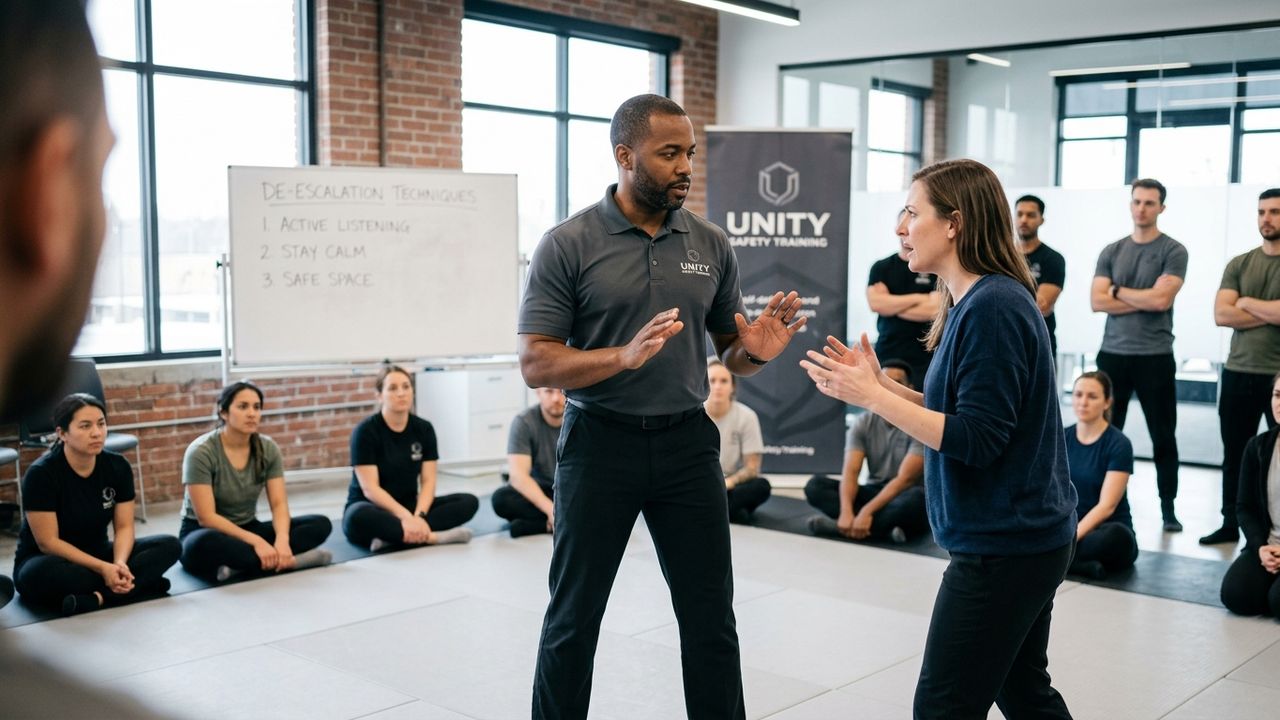
The most effective self-defense tool you own is your voice. De-escalation techniques for civilians are communication and awareness strategies that interrupt conflict before it becomes physical. When applied correctly, they reduce risk, protect everyone involved, and keep you in control of a situation without ever throwing a punch.
Why De-Escalation Is a Survival Skill, Not a Soft Skill
We live in a culture that tends to treat conflict resolution as something passive, even weak. That framing is wrong, and it can get people hurt. The ability to read a situation, regulate your own stress response, and redirect an agitated person with calm, deliberate language is one of the most demanding skills a person can develop. It requires situational awareness, emotional discipline, and practiced communication under pressure.
According to the U.S. Department of Justice, the vast majority of violent incidents involve some form of escalating verbal exchange before any physical contact occurs. That window of time is your opportunity. If you know how to use it, you may never need anything else.
What Does Escalation Actually Look Like?
Most people imagine conflict as a sudden explosion, but that is rarely how it works. Escalation is a process, and it has recognizable stages. We teach our students to spot the early indicators: raised voice, rigid posture, rapid breathing, invasion of personal space, and repetitive or circular language. These are signals that someone's stress response is taking over their rational thinking.
Understanding the escalation curve matters because your intervention needs to match the stage you are in. Responding to early agitation with the same intensity you would use in a near-physical confrontation can actually accelerate the situation rather than calm it. Timing and tone are everything.
Core De-Escalation Techniques for Civilians
These are the foundational techniques we cover in our civilian training programs. They are simple in concept and genuinely difficult to execute under stress, which is exactly why we practice them in realistic scenarios rather than just talking about them.
Control your own physiology first. You cannot calm someone else if your own stress response is running the show. Slow, deliberate breathing lowers your heart rate and keeps your voice steady. A calm voice is contagious in the best possible way.
Use open, non-threatening body language. Crossed arms, a bladed stance, or direct unbroken eye contact can all read as aggressive to someone who is already activated. Keep your hands visible, your posture relaxed, and your position slightly offset rather than squared up.
Validate without agreeing. Phrases like "I can see you are frustrated" or "That sounds really difficult" acknowledge the other person's emotional state without conceding any point or accepting blame. Feeling heard is one of the most powerful de-escalators that exists.
Offer choices, not commands. People in crisis often feel trapped or powerless. Giving someone a small, genuine choice restores a sense of control and reduces the urgency they feel to act out. "Would you like to step over here so we can talk, or would you prefer I give you a few minutes?" is far more effective than a direct order.
Know when to disengage. De-escalation is not about winning the conversation. If the situation is deteriorating despite your best efforts, creating distance and removing yourself is a completely valid and often smart choice. Ego has no place in personal safety.
Where Do These Situations Actually Happen?
Conflict does not reserve itself for dark alleys. We see it in grocery store parking lots, at youth sporting events, in office hallways, and at family gatherings. Road rage incidents, neighbor disputes, and customer service confrontations are among the most common scenarios our civilian students bring to us. The settings are ordinary. The emotional stakes are not.
This is why our [de-escalation training](https://incendiarytrainingservices.com/services/de-escalation-training) is built around the environments our students actually live and work in. We do not train for abstract threats. We train for the situations you are most likely to face, so your skills are ready when you need them.
Why Practice Matters More Than Theory
Reading about de-escalation and performing it under stress are two completely different experiences. When your heart rate spikes and someone is in your face, the techniques you have only read about tend to disappear. The ones you have drilled in realistic scenarios tend to hold. This is the same principle that drives all of our training, whether we are working on verbal skills or physical defensive techniques.
Our instructors hold an IKI (Israeli Krav International) Certified Instructor credential, Brazilian Black Belt credential, Monadnock Defensive Tactics (MDTS) Instructor credential, and a Personal Trainer certification. That breadth of training means we understand how the body and mind respond to threat, and we design our de-escalation curriculum to work with those responses rather than against them.
What Should You Do When De-Escalation Is Not Working?
We want to be honest with you here. Verbal de-escalation is powerful, but it is not a guarantee. Some individuals are in a mental health crisis, under the influence of substances, or simply committed to violence regardless of your response. In those cases, your priority shifts from resolution to protection.
This is why we teach de-escalation as part of a layered personal safety framework, not as a standalone solution. Awareness comes first. Verbal skills come second. Physical defense is the last resort, and we train for that too. Knowing where you are in that continuum at any given moment is itself a critical skill.
Ready to Build Skills That Actually Work Under Pressure?
We serve individuals, families, corporate teams, and community groups throughout Greater New Orleans and southeastern Louisiana, and because we are fully mobile, we come to your location so your team can train in the environment where they actually work and live. [Reach out today](https://incendiarytrainingservices.com/contact) to tell us about your group and we will build a session around your specific needs and schedule.


