De-Escalation Training for Employees: Why It Reduces Workplace Incidents
This post is part of our De-Escalation training resources.
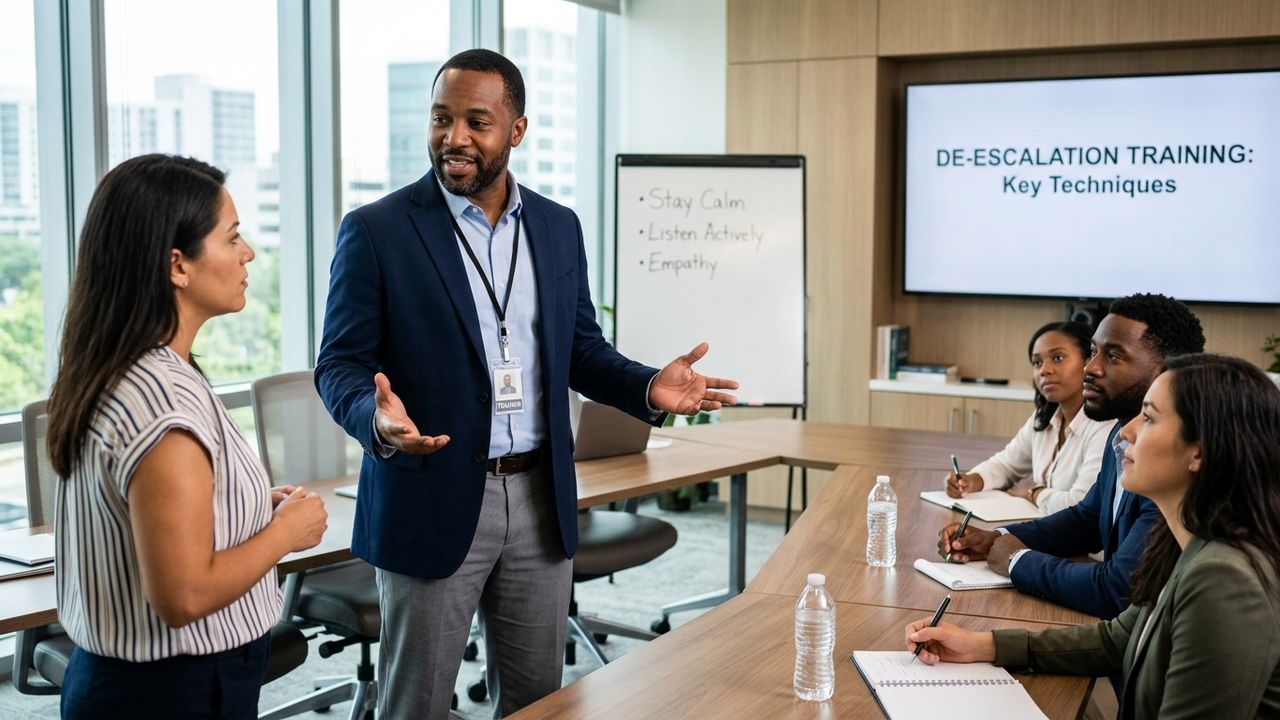
De-escalation training for employees works because it addresses conflict at its earliest, most manageable stage. When your team can recognize warning signs, regulate their own stress responses, and communicate with a person in crisis, many situations never reach the point of physical confrontation. That shift in awareness and skill is what drives measurable reductions in workplace incidents.
The Scope of Workplace Violence Is Larger Than Most Teams Realize
OSHA recognizes workplace violence as a serious occupational hazard, noting that it affects nearly two million American workers every year across industries ranging from healthcare and retail to logistics and corporate offices. Those numbers represent real people, real injuries, and real costs to organizations that could have invested in prevention instead. The vast majority of these incidents do not begin with a sudden, unpredictable explosion of violence. They begin with escalating tension, verbal aggression, and behavioral warning signs that trained employees can identify and interrupt.
We see this pattern consistently in the workplaces we train. The incident that ends in a physical altercation or a call to law enforcement almost always had a precursor. Someone was agitated for an extended period. A conversation went sideways. A customer or coworker showed signs of distress that nobody felt equipped to address. De-escalation training gives your people the vocabulary, the posture, and the confidence to step in at that earlier moment.
What Does De-Escalation Training for Employees Actually Teach?
Our [de-escalation training program](https://incendiarytrainingservices.com/services/de-escalation-training) is built around practical, scenario-driven skills that employees can actually use under pressure. We do not teach theory for its own sake. Every concept we introduce gets practiced in realistic role-play situations drawn from the types of conflicts your specific industry encounters.
Core skills we cover include situational awareness and early threat recognition, verbal communication techniques that reduce perceived threat, active listening and empathy-based response, body language and proxemics (how distance and posture affect a person in crisis), and personal boundary-setting that keeps your employee safe without escalating the situation further. We also address how stress affects decision-making, because an employee who understands their own physiological response to fear is far better equipped to stay calm and think clearly.
Why Scenario-Based Practice Is the Difference Between Training and Real Skill
Reading a handout about de-escalation does not prepare someone for the moment a customer is screaming six inches from their face. Watching a video does not build the muscle memory of keeping a calm, open posture when every instinct is telling you to tense up or back away. That gap between knowing and doing is exactly why we prioritize scenario work in every session we deliver.
Our instructors hold an IKI (Israeli Krav International) Certified Instructor credential, Brazilian Black Belt credential, Monadnock Defensive Tactics (MDTS) Instructor credential, and a Personal Trainer certification.
That depth of training background means we understand how people actually move, react, and freeze under stress. We design our scenarios to create just enough pressure that employees have to access their new skills under realistic conditions, not just recite them in a comfortable classroom. When the real moment comes, their nervous system has already been there before.
How Does This Training Protect Your Organization Beyond the Incident Itself?
The benefits of de-escalation training for employees extend well beyond preventing a single confrontation. Organizations that invest in this training consistently report improvements in employee confidence, reduced absenteeism related to workplace stress, and stronger team cohesion. When your people know they have the skills to handle a difficult situation, they show up differently. They are less anxious, more present, and more willing to engage with challenging customers or coworkers instead of avoiding the interaction entirely.
There is also a significant liability dimension. Employers have a general duty under OSHA guidelines to provide a workplace free from recognized hazards, and workplace violence is explicitly included in that framework. Documented, consistent safety training demonstrates that your organization takes that duty seriously. It is not a legal guarantee of any outcome, but it is a meaningful part of a defensible safety culture.
Who Benefits Most from Workplace De-Escalation Training?
The short answer is: any team that interacts with people under stress. That includes healthcare workers, retail and hospitality staff, property management teams, human resources professionals, front-line supervisors, and corporate leadership. We also work with law enforcement agencies looking to supplement their existing skills with additional scenario-based practice, framed as professional development rather than accredited certification hours.
We tailor every session to the specific environment and risk profile of the group we are training. A team of hospital intake coordinators faces different scenarios than a corporate HR department managing a difficult termination. We build the training around your reality, not a generic template, because generic training produces generic results.
Building a Safer Workplace Culture Starts with One Decision
A safer workplace does not happen by accident. It is built through deliberate investment in the skills and confidence of the people who show up every day. De-escalation training for employees is one of the highest-return investments an organization can make, because it addresses the human element at the center of every workplace conflict. When your team knows how to recognize tension early, respond with intention, and communicate in ways that reduce rather than amplify a threat, the entire culture shifts.
We are a mobile training service, which means we come to your location anywhere in Greater New Orleans and southeastern Louisiana. There is no need to pull your team off-site or coordinate travel. We bring the training to you, set up in your space, and deliver instruction that fits your schedule and your environment. [Reach out today](https://incendiarytrainingservices.com/contact) to talk with us about building a de-escalation training program for your team.


