Defensive Tactics for Healthcare Workers: Managing Aggressive Patients Safely in New Orleans
This post is part of our Defensive Tactics training resources.
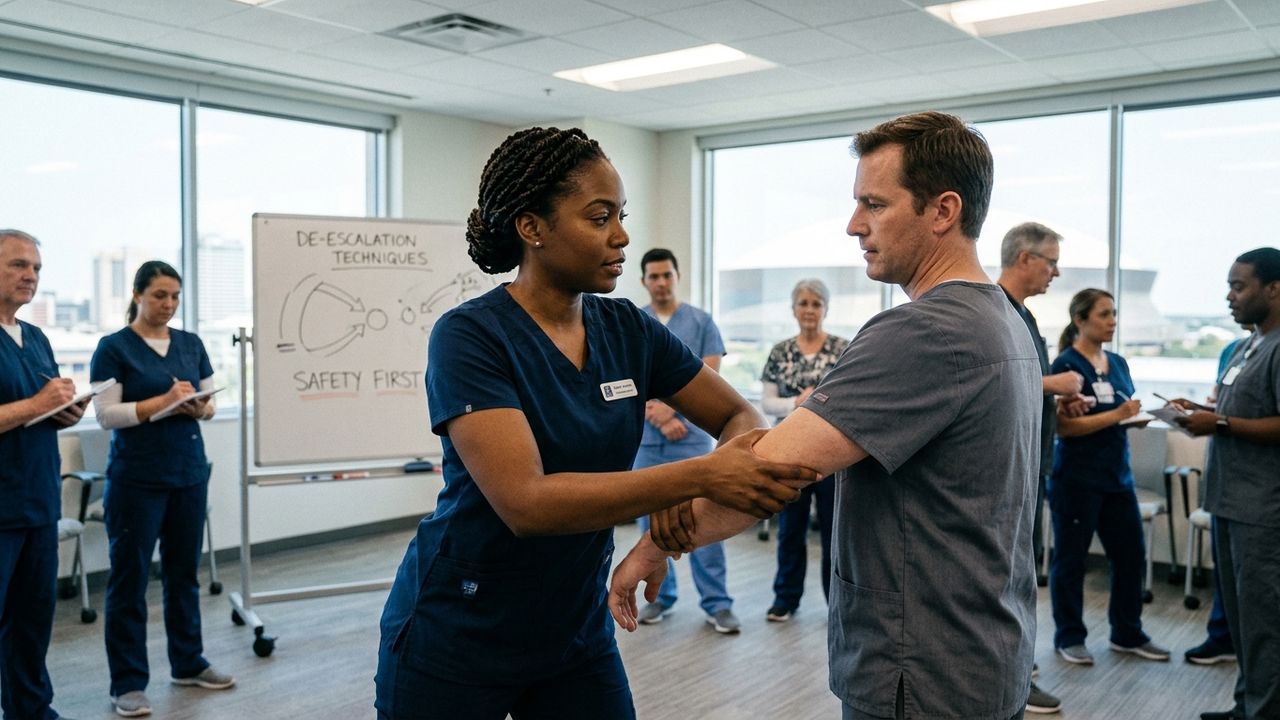
Healthcare workers can reduce their risk of injury during patient aggression by learning a small set of practical defensive tactics skills: verbal de-escalation, spatial awareness, safe disengagement from grabs, and controlled distance management. These skills do not require athletic ability or martial arts experience. They require good training, realistic practice, and a team that has rehearsed together.
Why Healthcare Settings Are High-Risk Environments
If you work in a hospital, clinic, emergency department, or behavioral health facility, you already know the tension that can build in a waiting room or treatment bay. What you may not know is how consistently the data backs up what you feel. According to OSHA, healthcare and social service workers are nearly five times more likely to experience workplace violence than workers in other industries. That is not a minor footnote. It is a systemic problem that demands a practical response.
Aggressive incidents in healthcare settings often escalate quickly and in confined spaces, exam rooms, hallways, elevator lobbies, parking structures. Staff are frequently alone with a patient. They may be physically close during a procedure. They often cannot simply walk away. That combination of proximity, isolation, and limited exit options is exactly why general workplace safety advice falls short, and why purpose-built defensive tactics training matters so much for clinical teams.
What Does Defensive Tactics Training Actually Cover for Healthcare Teams?
When we work with healthcare organizations, we build sessions around the real scenarios their staff encounter, not generic self-defense drills. Our curriculum for clinical environments typically covers several core areas.
Verbal de-escalation and threat recognition: Most physical confrontations give warning signs before they go hands-on. We train staff to read behavioral cues, use tone and language strategically, and create space before a situation becomes physical.
Spatial awareness and positioning: Where you stand in a room, how close you are to a door, and how you orient your body relative to an agitated person all affect your options. We teach staff to make these decisions automatically, without breaking the flow of patient care.
Grab releases and disengagement: Wrist grabs, hair pulls, shirt grabs, and bear hugs are among the most common physical attacks healthcare workers report. We drill simple, high-percentage releases that work under stress and do not require strength to execute.
Safe disengagement and exit strategy: The goal is never to win a fight. The goal is to get safe and get help. We emphasize controlled disengagement, creating distance, and moving toward support rather than escalating contact.
You can learn more about how we structure these sessions on our Defensive Tactics service page.
Why De-Escalation Alone Is Not Enough
De-escalation training is valuable, and we include it in everything we do. But verbal skills have limits. A patient in a psychotic episode, under the influence of substances, or in acute medical distress may not respond to calm language and open-ended questions. When verbal tools stop working, staff need a physical skill set to fall back on. Without that foundation, the only options are freeze, comply, or improvise under stress. None of those are good options.
We also want to be clear about something: physical defensive tactics skills make de-escalation more effective, not less. When a staff member feels confident that they can protect themselves if a situation goes wrong, they stay calmer during the verbal phase. That calm is contagious. It communicates to the patient that the person in front of them is in control, and that often changes the dynamic before anything physical happens.
What Should a Healthcare Facility Do Before Booking a Training Session?
Before we arrive, we encourage facilities to do a few things that make the training land better. First, identify the specific environments where incidents have occurred or are most likely. An emergency department triage area has different risk factors than a behavioral health unit or an outpatient clinic. The more specific you can be, the more targeted we can make the content.
Second, get leadership in the room. When managers and charge nurses participate alongside their teams, it signals that this is a priority, not a checkbox. It also gives leadership firsthand experience of what their staff are learning, which supports better incident response policies afterward.
Third, think about follow-up. A single session builds awareness and introduces skills. Repeated practice builds competence. We are happy to work with facilities on a recurring training schedule that keeps these skills sharp over time.
Who We Are and How We Train
We are Incendiary Training Services, a certified defensive tactics and self-defense training company based in Greater New Orleans. We are a mobile operation, which means we come to your facility, your conference room, your parking lot, wherever your team trains best. We do not require you to travel to a gym or training center.
Our instructors hold an IKI (Israeli Krav International) Certified Instructor credential, Brazilian Black Belt credential, Monadnock Defensive Tactics (MDTS) Instructor credential, and a Personal Trainer certification.
That combination of credentials means we bring both the technical depth and the instructional methodology to teach under-stress skills effectively to non-martial-artists. Healthcare workers are professionals with demanding jobs. We respect their time, meet them at their skill level, and focus on what is actually useful in their environment.
Building a Safer Culture in Your Clinical Environment
Workplace violence in healthcare is not inevitable, but it is also not solved by a single policy update or a laminated poster in the break room. It takes consistent investment in the people who are actually on the floor. When staff feel prepared, they make better decisions under pressure. They communicate more clearly with each other during a developing situation. They recover faster after an incident. That kind of team-level preparedness is what we work toward in every session we run.
We also want to be honest about what training cannot do. No training eliminates risk entirely. What it does is reduce the likelihood of injury, improve response quality, and give your team a shared language and set of skills to draw on when things go sideways. That is a meaningful improvement, and it is one your staff deserves.
If your healthcare team in Greater New Orleans or anywhere in southeastern Louisiana is ready to build real defensive tactics skills, we are ready to come to you. We are mobile, we are flexible, and we design every session around your team's actual environment and needs. Reach out today to start the conversation about what a training program could look like for your facility.


