Ground Defense Fundamentals: How to Recover When a Fight Goes to the Floor
This post is part of our Defensive Tactics training resources.
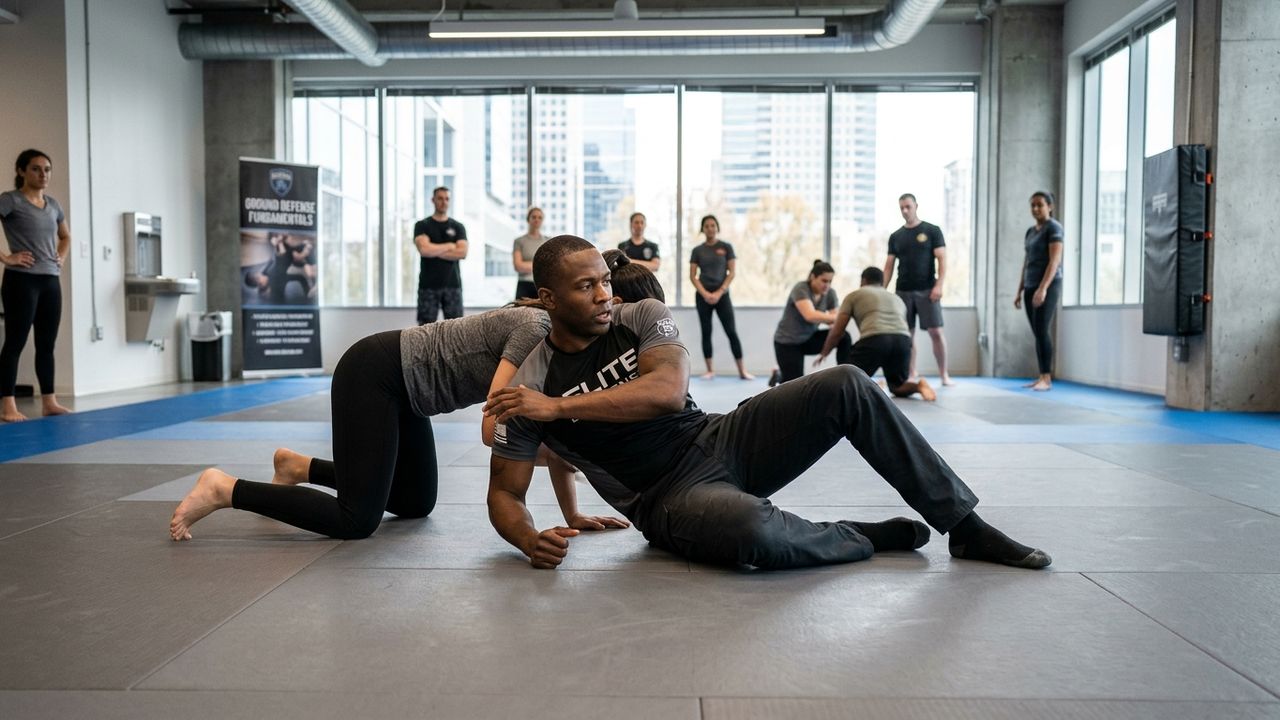
When a confrontation takes you to the ground, your priority is not to win a grappling match. Your priority is to protect yourself, create distance, and get back on your feet. The ground defense self defense techniques we teach are built around that single goal: survive the moment, recover your position, and exit the threat.
Why the Ground Is One of the Most Dangerous Places to Be in a Real Fight
The statistics around real-world violence are sobering. According to FBI crime data, a significant portion of physical assaults involve close-contact grappling or takedowns, meaning the fight rarely stays upright. Once you are on the ground, your mobility is compromised, your ability to disengage drops sharply, and the environment itself becomes a threat. Hard floors, curbs, and furniture can cause serious injury even before an attacker does anything further.
We also have to account for secondary threats. A real assault rarely involves a single, cooperative attacker in an open gym. There may be bystanders, accomplices, or obstacles. Staying on the ground for any longer than necessary is not a tactical option. That is why every ground defense skill we teach is oriented toward recovery and escape, not prolonged ground fighting.
The Foundation: Positional Awareness and the Protective Guard
Before you can recover from the ground, you need to know where you are on it. Positional awareness means understanding whether you are on your back, your side, face down, or partially upright, and immediately orienting your body to reduce vulnerability. We train students to develop this awareness as a reflex, not a conscious calculation.
The protective guard is the starting point for most ground defense scenarios. When on your back, you keep your feet between you and the threat, your chin tucked, and your hands up to protect your head. This is not a fighting position. It is a survival position that buys you the fraction of a second you need to assess and move. From here, we teach students to use leg frames, hip escapes, and controlled rolls to create the space needed to stand.
What Are the Core Ground Defense Self Defense Techniques We Teach?
Our curriculum draws from multiple disciplines, integrated into a practical system. Here are the core skill categories we cover in ground defense training:
Fall Breaking and Impact Reduction: Getting taken down without knowing how to fall safely can end the fight before it starts. We teach controlled falling mechanics so that students absorb impact without injury and land in a recoverable position.
Hip Escapes and Frame Work: The hip escape, sometimes called a shrimp movement, is one of the most transferable skills in ground defense. It allows you to move your hips away from an attacker, rebuild your guard, and create the space needed to stand or strike. Frames, meaning using your arms and legs as structural barriers, prevent an attacker from closing distance and pinning your weight.
Ground-to-Standing Recovery: We drill multiple pathways back to your feet depending on what the attacker is doing. These include technical standup sequences, roll-to-knee transitions, and explosive recovery movements. Every pathway is practiced under pressure so that the movement becomes automatic.
Defensive Striking from the Ground: Sometimes creating distance requires a strike first. We teach targeted, high-percentage strikes from the ground, including heel kicks, palm strikes, and elbow strikes, that are designed to interrupt an attacker's movement and buy you the moment you need to recover.
How Does This Apply to Law Enforcement and Workplace Safety Teams?
Ground defense is not just a civilian concern. Law enforcement officers and workplace safety personnel face ground-level confrontations regularly, and the consequences of poor ground recovery can be severe. We work with law enforcement teams as a supplemental skill-building resource, helping officers sharpen their ground recovery and control skills outside of formal departmental training cycles. This is not accredited continuing education or POST-certified training. It is focused, practical repetition that reinforces what officers already know and fills gaps in their ground game.
For corporate and workplace teams, ground defense fits naturally into a broader conversation about personal safety and de-escalation. We cover how to avoid situations that lead to physical confrontation in the first place, and we give teams the physical skills to manage a worst-case scenario if de-escalation fails. You can explore the full scope of what we offer through our Defensive Tactics service page.
The Credential Behind the Curriculum
Our instructors hold an IKI (Israeli Krav International) Certified Instructor credential, Brazilian Black Belt credential, Monadnock Defensive Tactics (MDTS) Instructor credential, and a Personal Trainer certification. That combination means our ground defense curriculum is informed by real-world combatives, deep grappling expertise, and an understanding of how the body moves and adapts under stress. We do not teach sport. We teach survival.
What to Expect in a Ground Defense Training Session
We begin every session with a movement warm-up that doubles as skill introduction. Students learn to move on the ground before they ever face a training partner. From there, we build in progressive drilling: solo repetitions, partner-assisted practice, and finally scenario-based pressure testing where students apply what they have learned under controlled resistance.
We scale every drill to the group. If you are training a mixed-fitness corporate team, we adjust intensity and complexity so that every participant walks away with skills they can actually use. If you are a law enforcement unit looking for sharper ground recovery under stress, we push the pace accordingly. The session ends with a debrief so that every student understands not just what they practiced, but why it works.
Bring Ground Defense Training to Your Team
We serve individuals, corporate teams, and law enforcement personnel throughout Greater New Orleans and southeastern Louisiana, and because we are fully mobile, we come to you. No gym membership, no travel burden on your team, no unfamiliar environment. We bring the mats, the curriculum, and the expertise directly to your location. [Reach out today](https://incendiarytrainingservices.com/contact) to schedule a ground defense session or to talk through a custom training plan that fits your team's goals and schedule.


