Hospitality Staff Safety Training in New Orleans: How Hotels and Hospitality Businesses Can Protect Staff from Guest Confrontations
This post is part of our Corporate Safety training resources.
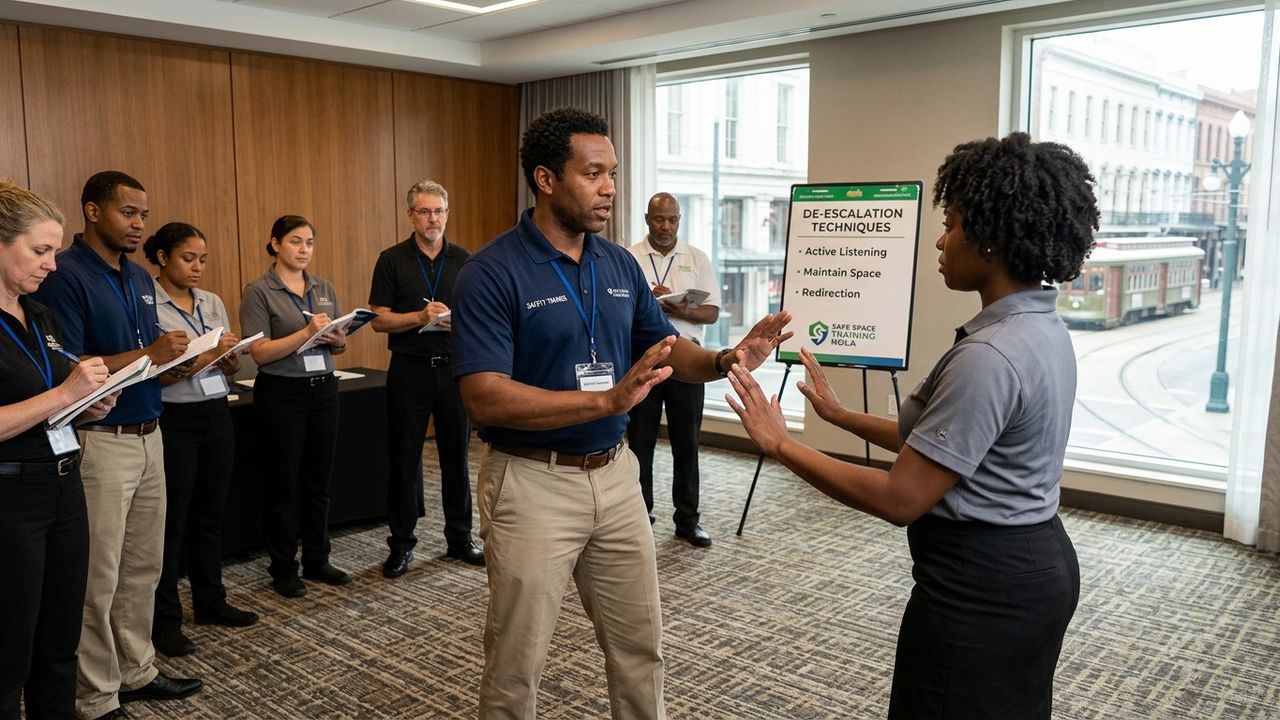
Hotels and hospitality businesses can protect their staff from guest confrontations by investing in structured de-escalation training, situational awareness coaching, and practical defensive tactics. When employees know how to read a situation early, communicate under pressure, and create safe distance if needed, they are far better equipped to manage difficult encounters without the situation escalating further.
Why Hospitality Workers Face Elevated Risk
Hospitality workers are on the front lines of public interaction every single shift. Front desk agents handle late-night check-ins with intoxicated guests. Housekeeping staff enter occupied rooms alone. Restaurant servers manage complaints that can turn hostile in seconds. The environment is inherently unpredictable, and the expectation to remain calm and professional can leave employees feeling like they have no permission to protect themselves.
According to OSHA, workers in service industries, including hotel and food service sectors, face a disproportionately high rate of workplace violence compared to many other industries. OSHA classifies workplace violence into four types, and hospitality workers regularly encounter Type II violence, meaning violence committed by customers or guests they are serving. That classification matters because it shapes how we design training: the threat is not a stranger breaking in, it is someone your staff is actively trying to help.
What Does Effective Hospitality Staff Safety Training Actually Look Like?
Effective training is not a lecture about company policy. It is hands-on, scenario-based, and built around the specific situations your team actually faces. We structure our corporate sessions around three core pillars: awareness, communication, and physical response. Each one builds on the last, and none of them require your staff to become fighters. The goal is confidence and control, not aggression.
Awareness training teaches staff to recognize pre-attack indicators and behavioral cues before a situation becomes physical. We cover proxemics (the use of space and distance), environmental positioning, and how to identify when a guest is escalating rather than just frustrated. Communication training focuses on verbal de-escalation, tone control, and how to set firm limits without triggering a defensive reaction in the other person. Physical response training introduces simple, high-percentage techniques for creating distance and breaking contact if a guest becomes physically aggressive.
Our instructors hold an IKI (Israeli Krav International) Certified Instructor credential, Brazilian Black Belt credential, Monadnock Defensive Tactics (MDTS) Instructor credential, and a Personal Trainer certification.
De-Escalation Is the First Line of Defense
We want to be clear about something: the best physical technique is the one you never have to use. De-escalation is not a soft skill, it is a tactical skill. When a front desk agent can recognize that a guest is moving from frustration into aggression and shift their own communication style accordingly, they are actively reducing risk for themselves, their coworkers, and the guest.
We train staff to use what we call the calm-anchor approach: slowing their own speech, lowering their vocal register, and using open body language to signal that they are not a threat while still maintaining a position of control. These are learnable, repeatable skills. They do not require years of practice, and they work across a wide range of confrontational scenarios, from an irate guest at the front desk to a disruptive patron in a hotel bar.
How Should Your Team Respond When De-Escalation Fails?
Sometimes a guest will not be talked down. Intoxication, mental health crises, or sheer volatility can push a situation past the point where words alone are enough. That is where physical skills become important, and where most hospitality teams are completely unprepared. We do not train your staff to fight. We train them to create distance, disengage safely, and get to a position where they can call for backup or exit the situation.
The physical techniques we teach are drawn from proven defensive systems and are adapted for real-world application in confined spaces like hotel corridors, elevator lobbies, and front desk areas. We also cover what to do immediately after an incident: how to support a coworker who was involved, how to document what happened, and how to communicate with management and law enforcement. The response does not end when the guest leaves.
Building a Culture of Safety Across Your Entire Property
One training session is a strong start, but a real safety culture requires consistency. We work with hospitality leadership to identify the highest-risk roles and locations on a property, then build a training plan that addresses those gaps systematically. That might mean a foundational session for all guest-facing staff, a more advanced session for supervisors and managers, and periodic refreshers to keep skills sharp.
We also help teams develop internal protocols: how to signal a coworker that you need backup without alerting a guest, how to safely remove someone from a space, and how to coordinate with local law enforcement when a situation requires it. You can learn more about how we structure these programs on our Corporate Safety services page. These are not generic workplace violence policies, they are practical, tested frameworks that your team can actually use under pressure.
Why New Orleans Hospitality Businesses Need This Now
New Orleans is one of the most visited cities in the United States. The hospitality industry here operates at a scale and intensity that few other markets match. French Quarter hotels, convention center properties, and entertainment district venues all deal with high guest volumes, late-night activity, and the specific challenges that come with a city known for its nightlife culture. That environment creates real risk for staff, and it demands real preparation.
We are based in Greater New Orleans and we understand this market. We know the layout of the properties, the rhythms of the tourist season, and the specific dynamics that make hospitality work here different from anywhere else. When we train your team, we are not delivering a generic curriculum built for a suburban office park. We are building something that fits your property, your staff, and your guests.
If you are ready to give your hospitality team the skills and confidence they need to handle guest confrontations safely, we are ready to come to you. We serve Greater New Orleans and southeastern Louisiana, and because we are fully mobile, we bring the training directly to your property. No offsite travel, no disruption to your operations. [Reach out today](https://incendiarytrainingservices.com/contact) to start a conversation about what the right program looks like for your team.


