Verbal De-Escalation Techniques Anyone Can Use in a Threatening Situation
This post is part of our De-Escalation training resources.
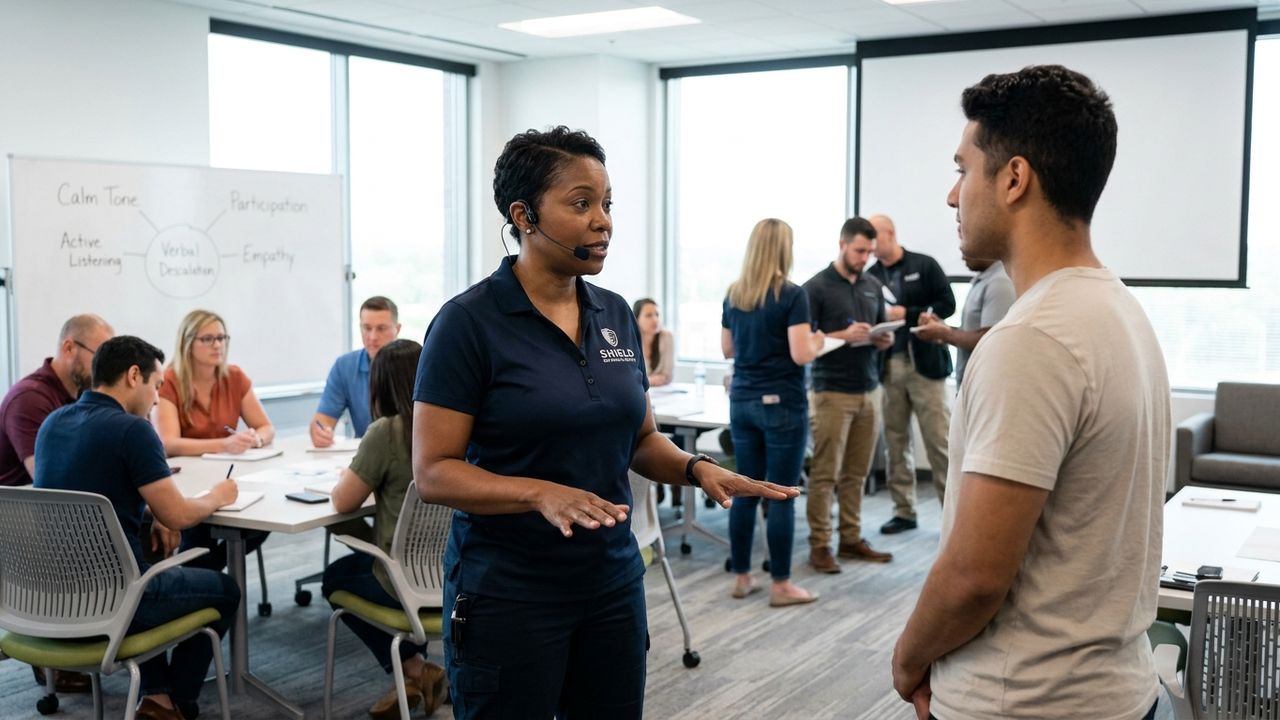
Verbal de-escalation techniques work in everyday situations because they address the root of most conflicts: emotion running ahead of reason. By using a calm tone, deliberate word choice, and active listening, you can interrupt an escalating situation before it turns physical. You do not need special training to start, but structured practice makes these skills reliable under pressure.
Why Verbal De-Escalation Matters More Than You Think
Workplace violence is not a rare edge case. According to the Occupational Safety and Health Administration (OSHA), nearly two million American workers report being victims of workplace violence each year, and many more incidents go unreported. That number includes threats, intimidation, and verbal confrontations, not just physical assaults. The vast majority of those situations had warning signs and a window of opportunity where the right words could have changed the outcome.
We train teams to recognize that window and use it. Physical defensive skills matter, and we teach those too, but the ability to talk a situation down is faster, safer, and available to everyone in the room, regardless of size or fitness level.
What Is Actually Happening When a Situation Escalates?
Before we talk technique, we need to talk about what is happening in the other person's brain. When someone feels threatened, disrespected, or cornered, their nervous system shifts into a fight-or-flight state. Rational thinking takes a back seat. That means logic and argument are almost useless at the peak of an escalation. What the brain responds to in that state is tone, body language, and the feeling of being heard.
This is why de-escalation is not about winning an argument. It is about lowering the emotional temperature so that reason can re-enter the conversation. Once you understand that, the techniques below make a lot more sense.
Core Verbal De-Escalation Techniques for Everyday Situations
Control your own voice first. Your tone is contagious. A raised, sharp voice signals threat and triggers a defensive response. A slow, low, steady voice signals safety. Before you say anything else, take a breath and consciously drop your pitch and pace. This single adjustment changes how the other person's nervous system reads the interaction.
Use their name and acknowledge their emotion. Saying someone's name cuts through the noise and signals that you see them as a person. Acknowledging what they are feeling, without agreeing with their behavior, validates their experience and reduces the need to escalate further to be heard. Try something like: 'I can see you are frustrated, and I want to understand what is going on.' That is not weakness. That is strategy.
Ask open-ended questions. Questions that require more than a yes or no answer shift the person from reactive mode to thinking mode. 'What would help right now?' or 'Can you help me understand what happened?' are simple prompts that invite engagement rather than confrontation. The act of formulating an answer requires the brain to slow down.
Give them a sense of control. Most escalating situations involve someone who feels powerless or dismissed. Offering small, genuine choices restores a sense of agency. 'Would you prefer to talk here or step somewhere quieter?' is not a concession. It is a redirect that puts them in a decision-making role rather than a reactive one.
Avoid trigger phrases. Certain phrases reliably pour fuel on a fire. 'Calm down,' 'You need to relax,' and 'That is not my problem' are near-universal escalators. So is any sentence that starts with 'You always' or 'You never.' We coach teams to replace these reflexive responses with language that keeps the door open rather than slamming it shut.
How Does Body Language Fit Into Verbal De-Escalation?
Your words and your body need to tell the same story. If you are saying 'I want to help' while standing square, arms crossed, and invading someone's personal space, your body is broadcasting a challenge. We teach what we call a non-threatening interview stance: slight angle to the person, open hands visible, relaxed shoulders, and enough distance to give both parties breathing room. This posture communicates openness without telegraphing submission.
Eye contact matters too. Sustained, hard eye contact reads as a dominance challenge. Intermittent, natural eye contact reads as attentiveness. That distinction is small but significant when someone is already on edge.
When Verbal De-Escalation Is Not Enough
Verbal skills are powerful, but they are not a guarantee, and we will never tell you otherwise. Some situations move past the point where words can help. That is why our training does not stop at communication. We integrate de-escalation into a broader framework that includes situational awareness, physical defensive skills, and team response protocols. Knowing when to stop talking and start moving is just as important as knowing what to say.
Our instructors hold an IKI (Israeli Krav International) Certified Instructor credential, Brazilian Black Belt credential, Monadnock Defensive Tactics (MDTS) Instructor credential, and a Personal Trainer certification.
That combination means we can meet your team wherever they are on the threat continuum, from a tense customer interaction all the way to a physical confrontation. You can learn more about how we structure this on our De-Escalation Training service page.
Making These Skills Stick: Practice Over Theory
Reading about de-escalation and performing it under stress are two very different things. The techniques above are straightforward on paper, but when your own adrenaline is spiking, your voice wants to rise, your jaw wants to clench, and your instinct is to match the other person's energy. That is why scenario-based practice is non-negotiable in our training model.
We run realistic role-play scenarios that put participants in the emotional context of a real confrontation. The discomfort is the point. Stress inoculation in a controlled training environment is what builds the muscle memory to respond instead of react when it counts.
We serve corporate teams, law enforcement, and civilians across Greater New Orleans and southeastern Louisiana, and because we are fully mobile, we bring the training to your location. There is no need to coordinate travel or rent a facility. [Reach out today](https://incendiarytrainingservices.com/contact) to talk through your team's needs and schedule a session that works for you.


