Escape and Evasion Basics: How to Break Contact and Get to Safety
This post is part of our Self-Defense Training training resources.
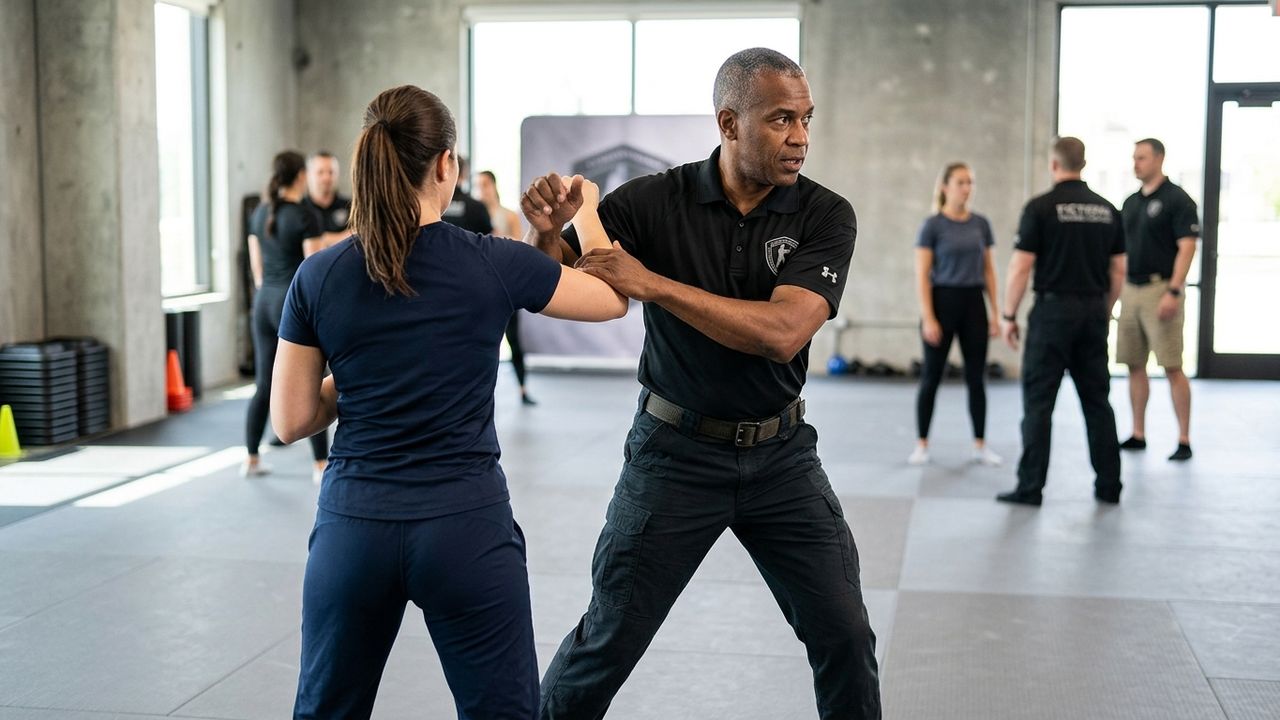
Escape and evasion self defense comes down to one core principle: your goal is to get away, not to win a fight. The most effective response to a threat is to recognize it early, create distance, and move toward safety before physical contact ever occurs. Everything we teach builds outward from that idea.
Why Escape Is Always the First Option
We live in a culture that sometimes romanticizes standing your ground. Movies reward the hero who stays and fights. Real life does not work that way. Every moment you remain in proximity to a threat is a moment something can go wrong, regardless of your skill level or physical condition. The Department of Homeland Security's "Run, Hide, Fight" guidance, developed for active threat situations, puts running first for exactly this reason. Distance is your most reliable tool.
This is not about being passive. Choosing to escape is an active, deliberate decision that requires training, situational awareness, and the confidence to act under stress. We build all three of those qualities in our [self-defense training](https://incendiarytrainingservices.com/services/self-defense-training) programs, and escape and evasion principles run through every session we teach.
What Does "Breaking Contact" Actually Mean?
Breaking contact means deliberately disengaging from a threat, whether that threat is verbal, physical, or environmental. It is not the same as simply running away in a panic. Panic gets people hurt. Breaking contact is a structured process with three stages: recognition, decision, and movement.
Recognition means identifying a threat before it escalates. We train people to read pre-attack indicators, environmental cues, and behavioral patterns that signal danger is developing. Decision means committing to an exit strategy quickly and without hesitation. Movement means executing that strategy with purpose, using angles, obstacles, and terrain to your advantage rather than running in a straight line toward an unknown destination.
Situational Awareness: The Skill That Makes Everything Else Work
You cannot escape a threat you did not see coming. Situational awareness is the foundation of every escape and evasion skill we teach. We use a practical framework based on Colonel Jeff Cooper's color code system, adapted for everyday civilian and professional environments. The goal is not paranoia. It is a relaxed, sustainable level of attention that keeps you oriented to your surroundings without burning you out.
In practical terms, this means knowing where the exits are when you enter a space, identifying who is in your environment and how they are behaving, and having a rough mental plan before a problem develops. Most people never do this. The ones who do are dramatically better positioned to act quickly when something goes wrong.
Movement Principles: How to Move When It Matters
When we teach movement for escape and evasion, we focus on a few core ideas. First, move off the line of attack immediately. Whether someone is approaching aggressively on foot or a situation is escalating in a crowd, stepping laterally rather than straight back buys you time and disrupts a threat's ability to track you. Second, use cover and concealment. Cover stops projectiles. Concealment hides you. Knowing the difference and using both intelligently can change an outcome entirely.
Third, move toward a known safe point, not just away from the threat. Many people in high-stress situations run without a destination in mind and end up cornered or isolated. We train you to identify exit points and rally locations in advance so that when stress hits, your brain already has a plan to execute.
What Happens When You Cannot Simply Run?
Sometimes escape is not immediately possible. You may be grabbed, blocked, or in a confined space. This is where physical technique becomes necessary, but even here the goal remains the same: create enough space and time to disengage and move. We teach wrist releases, clinch escapes, and basic striking combinations not as a fighting system, but as tools to buy the seconds you need to get away.
Our instructors hold an IKI (Israeli Krav International) Certified Instructor credential, Brazilian Black Belt credential, Monadnock Defensive Tactics (MDTS) Instructor credential, and a Personal Trainer certification. That combination means we can address the physical, tactical, and conditioning dimensions of escape and evasion in a single, integrated program rather than treating them as separate subjects.
Training Under Stress: Why Drills Matter More Than Lectures
Information alone does not build skill. You can read every article ever written about escape and evasion self defense and still freeze when adrenaline hits. The reason is simple: stress degrades fine motor skills and narrows your attention. Skills that have not been practiced under pressure will often fail under pressure. This is not a criticism. It is biology, and it is why scenario-based training is non-negotiable in everything we do.
We use progressive stress inoculation in our sessions, starting with slow, deliberate practice and building toward realistic scenarios that simulate the chaos and pressure of an actual threat. By the time a student finishes a session with us, they have physically rehearsed the decisions they may one day need to make. That repetition is what makes skills accessible when it counts.
Who Should Train in Escape and Evasion Skills?
The short answer is everyone. We work with corporate teams who want practical workplace safety skills, law enforcement professionals looking to supplement their existing training, and civilians who simply want to be more prepared in daily life. Escape and evasion principles apply across all of those groups because the underlying human factors, stress, decision-making under pressure, and spatial awareness, are universal.
For corporate teams in particular, this type of training addresses a real and documented concern. The FBI's research on workplace violence consistently identifies that most incidents involve some period of observable warning behavior before an attack occurs. Training your team to recognize those indicators and respond with a clear, practiced plan is one of the most practical investments an organization can make in its people.
If you are ready to build real escape and evasion self defense skills for yourself or your team, we are here to help. We serve Greater New Orleans and southeastern Louisiana, and because we are fully mobile, we come to your location so your team can train in the environment where they actually work and live. [Reach out today](https://incendiarytrainingservices.com/contact) to talk through your goals and schedule a session.


