The Role of Stress Inoculation in Real-World Self-Defense Preparedness
This post is part of our Self-Defense Training training resources.
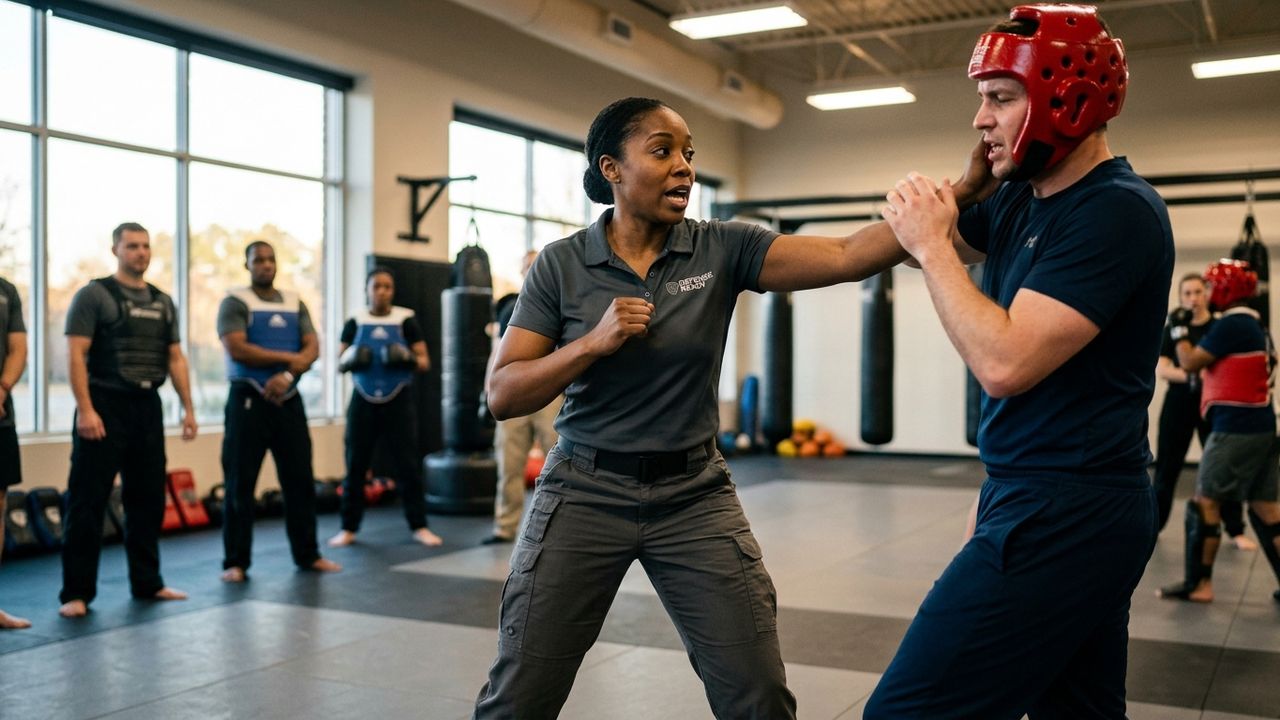
Stress inoculation self defense training works by deliberately exposing you to controlled, escalating pressure during practice so your nervous system learns to function when adrenaline spikes. Without it, even well-rehearsed techniques tend to fall apart in a real confrontation. With it, your body stops treating danger as a surprise and starts treating it as a problem to solve.
Why Your Brain Works Against You in a Crisis
When a threat appears, your body floods with cortisol and adrenaline within seconds. Heart rate climbs, fine motor skills degrade, tunnel vision sets in, and your prefrontal cortex, the part responsible for complex decision-making, essentially goes offline. This is not a character flaw. It is human biology, and it affects everyone from first-time students to seasoned professionals.
The problem with most conventional self-defense classes is that they train the calm version of you. Techniques are drilled in a cooperative, low-stakes environment where nobody is yelling, nobody is grabbing unexpectedly, and your heart rate sits comfortably at rest. That version of you rarely shows up in a real altercation. We design our training to meet the version of you that actually will.
What Is Stress Inoculation and How Does It Actually Work?
Stress inoculation is a training methodology borrowed from military and law enforcement preparation. The core idea is simple: expose a person to progressively more realistic and demanding stress scenarios during training so that the physiological and psychological responses to danger become familiar rather than paralyzing. Over repeated exposures, the nervous system recalibrates. What once triggered panic begins to trigger a trained response instead.
In practice, this means we use tools like elevated heart-rate drills before technique work, verbal aggression from training partners, scenario-based role-playing with realistic context, and timed pressure tests. We do not manufacture chaos for its own sake. Every stressor we introduce has a specific training purpose, and we control the intensity so participants are challenged without being overwhelmed. The research on this approach is well-established: the U.S. Army Research Laboratory and numerous peer-reviewed studies in applied psychology have documented that stress exposure training significantly improves performance under threat conditions compared to technique-only instruction.
The Gap Between Knowing and Doing
We see this gap constantly. A student can demonstrate a wrist release perfectly in a slow, cooperative drill. Then we add a realistic grab, a raised voice, and a ticking clock, and the technique evaporates. This is not a failure of the student. It is a failure of the training method. Knowing a movement and owning it under pressure are completely different neurological achievements.
Our approach, rooted in the systems behind our credentials, closes that gap deliberately. Our instructors hold an IKI (Israeli Krav International) Certified Instructor credential, Brazilian Black Belt credential, Monadnock Defensive Tactics (MDTS) Instructor credential, and a Personal Trainer certification. Each of those disciplines informs how we layer stress into skill development. The result is a student who does not just know what to do but has actually done it under conditions that approximate real threat dynamics.
Who Benefits from Stress Inoculation Training?
The short answer is: almost everyone. Civilians who want genuine personal safety skills, not just a weekend seminar certificate, benefit enormously. Corporate teams that want to move beyond passive active-threat awareness videos and into applied, embodied preparedness benefit. Law enforcement professionals looking for supplemental skill-building outside of their agency's standard curriculum benefit. The FBI's Uniform Crime Report and workplace violence data from OSHA both consistently show that violent incidents are not limited to high-crime areas or specific industries. Threat exposure is broadly distributed, and so is the need for realistic preparation.
We tailor the stress load to the audience. A corporate group working on de-escalation and escape skills gets a different intensity curve than a law enforcement team refining control techniques. The underlying principle is the same: we build the skill first, then we stress-test it until it holds. You can explore the full range of what we offer on our Self-Defense Training service page at https://incendiarytrainingservices.com/services/self-defense-training, where we break down our program options for individuals, groups, and organizations.
What Does a Stress Inoculation Session Actually Look Like?
A typical session with us begins with physical activation, getting your heart rate elevated before any technique instruction begins. This is intentional. We want you learning and drilling while your body is already in a mild stress state, not in the comfortable baseline you walked in with. From there, we introduce the core skills of the session, whether that is striking fundamentals, clinch defense, or situational awareness and avoidance.
As the session progresses, we layer in scenario-based pressure. Partners become less cooperative. Verbal cues are added. Decisions must be made faster. By the end of a well-structured session, participants have not just learned a skill. They have tested it against something that felt real. That feeling is the point. It is the neurological imprint that makes training transfer to actual situations.
Building Confidence That Holds Under Pressure
One of the most consistent things we hear from participants after stress inoculation training is that they feel genuinely calmer in everyday high-pressure situations, not just in physical threat scenarios. That is because the breath control, decision-making under load, and self-regulation skills you develop in this kind of training are transferable. We are not in the business of making promises about safety outcomes, because no training program can guarantee what will happen in a real event. What we can say with confidence is that people who have been stress-inoculated perform measurably better than those who have only drilled in calm conditions.
Real preparedness is not about memorizing a checklist. It is about having a nervous system that has been there before, at least in training, and knows how to come back online. That is what we build, and it is why stress inoculation sits at the center of everything we teach.
If you are ready to train in a way that actually prepares you for the real world, we are ready to come to you. We serve Greater New Orleans and southeastern Louisiana, and because we are fully mobile, we bring the training directly to your location. [Reach out today](https://incendiarytrainingservices.com/contact) to schedule a session for your team, your organization, or yourself, and let us build something that holds up when it matters most.
