How to Build a Personal Safety Routine That Actually Works in High-Crime Urban Areas
This post is part of our Self-Defense Training training resources.
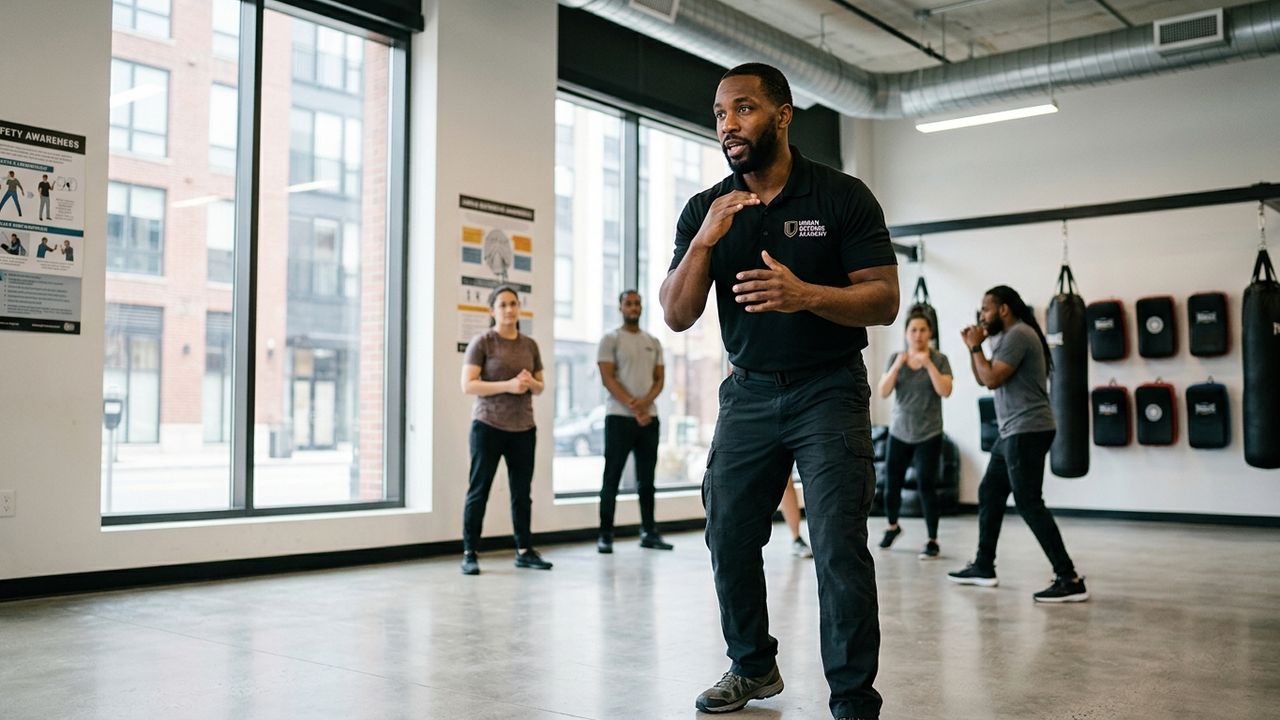
Building a personal safety routine for a high-crime urban area comes down to three pillars: consistent situational awareness, practiced physical skills, and a clear decision-making framework. You do not need to become a martial artist or live in a state of anxiety. You need repeatable habits, trained instincts, and a realistic plan you can actually follow.
Why Personal Safety Tips for High-Crime Areas Start with Your Mindset
Most people approach personal safety backwards. They focus on the physical techniques first and skip the mental framework that makes those techniques usable. We teach our clients that the most powerful safety tool they own is their attention. The FBI's research on violent crime consistently shows that most attacks are not random. Offenders select targets based on perceived vulnerability, and perceived vulnerability is largely a function of how aware and confident a person appears.
That means your first line of defense is not a technique. It is your posture, your eye contact, your pace, and your awareness of what is happening around you. We call this the baseline habit: know what normal looks like in your environment so that anything abnormal registers immediately. This is a trainable skill, and it costs nothing to start practicing today.
What Does a Daily Personal Safety Routine Actually Look Like?
A sustainable safety routine is not a checklist you run through once a week. It is a set of micro-habits layered into your existing day. Here is how we break it down for our clients.
Environmental scanning: Every time you enter a new space, spend five seconds identifying exits, noting who is present, and flagging anything that feels off. This becomes automatic faster than most people expect.
Phone discipline: Staring at a screen while walking through a high-traffic urban area is one of the fastest ways to signal that you are not paying attention. We coach clients to use their phones intentionally, not reflexively, especially in transitional spaces like parking lots, stairwells, and transit stops.
Route awareness: Know at least two routes to and from the places you frequent. Predictable patterns make you easier to target. Vary your timing and your path when possible, and always have a mental plan for where you would go if something went wrong.
Verbal boundary-setting: Most confrontations begin with a verbal exchange. Practicing clear, calm, assertive communication is a physical safety skill. We train this directly in our sessions because the ability to de-escalate a situation verbally is often more valuable than any physical technique.
Building Physical Skills That Hold Up Under Stress
Awareness and de-escalation will resolve the vast majority of threatening situations before they become physical. But not every situation. When physical defense becomes necessary, you need skills that are simple, gross-motor, and pressure-tested. Complicated techniques fall apart under adrenaline. Simple ones hold.
Our self-defense training focuses on exactly this. We draw from a curriculum built on real-world application, and our instructors hold an IKI (Israeli Krav International) Certified Instructor credential, Brazilian Black Belt credential, Monadnock Defensive Tactics (MDTS) Instructor credential, and a Personal Trainer certification. That combination means we can teach you how to move, how to protect yourself under pressure, and how to build the physical conditioning to back it up. You can learn more about what we cover on our Self-Defense Training service page.
How Do You Know If Your Routine Is Actually Working?
This is a question we get often, and it is a fair one. The honest answer is that a good personal safety routine is working when you stop noticing it, because the habits have become automatic. You scan a room without thinking about it. You position yourself near an exit without deliberating. You recognize a pre-attack indicator before it fully registers consciously.
The other indicator is confidence. Not arrogance, not aggression, but a calm, grounded sense that you have a plan and you have practiced it. That confidence changes how you carry yourself, and as we noted earlier, how you carry yourself changes how you are perceived by people who are looking for easy targets.
The Role of Community and Shared Awareness
Personal safety is not purely an individual project. The neighborhoods and workplaces where people feel safest are typically ones where residents and colleagues look out for each other, share information about local concerns, and have a shared language around safety. We encourage our clients to bring their households, their teams, and their neighbors into the conversation.
When a group trains together, they develop a shared baseline. They know how each other responds under stress. They can communicate quickly and coordinate without confusion. This is why we work with corporate teams, neighborhood groups, and households, not just individuals. The more people around you who are trained and aware, the safer everyone becomes.
Putting It All Together: Your Starting Point
You do not need to overhaul your life to start building a stronger personal safety routine. Start with awareness. Practice your environmental scan every time you walk into a new space this week. Add verbal boundary-setting practice. Then, when you are ready to add physical skills to your foundation, get trained by people who know how to teach them correctly.
A personal safety routine built on solid fundamentals, practiced consistently, and reinforced through quality training is one of the most meaningful investments you can make in your own wellbeing. We are here to help you build it, step by step, at whatever pace works for you.
We serve individuals, households, and teams across Greater New Orleans and southeastern Louisiana, and because we are fully mobile, we come to you. Whether you want to train at your home, your office, or your community space, we bring the instruction to your location. Reach out today to talk through your goals and schedule a session that fits your life.

